
Showing posts with label conspiracy theories. Show all posts
Showing posts with label conspiracy theories. Show all posts
Friday, June 21, 2019

Saturday, February 24, 2018
EYES WIDE CUT ~ A FILMMAKER RE-CUTS KUBRICK'S UNFINISHED FILM

Those venerable cinema hipsters at Film Threat are reporting on actor/director Marshall Allman's decision to re-cut Kubrick's final (and, imo, uncompleted) film, Eyes Wide Shut. It begins, in part:
When did we stop thinking deeply about movies? We consume films so quickly that we barely take time to breath before the next event film hits the stadium-seated multiplex. Many of the themes in movies made today are not far below the surface–themes are piled right on the top, they’re easy to spot and often spoken aloud in case audiences missed it. I miss films that provoke thought and conversation, weeks, months, years, even decades after its release. It’s rare to see a cinematic experience that creeps into your subconscious, marinating with ideas, then spewing forth some kind of understanding.
Stanley Kubrick made those kinds of films every single time. Sure, some landed more successfully than others, however, I’m still watching 2001 hoping to grasp more about that trip to space.
Unfortunately, upon its initial release in 1999, Kubrick’s final film Eyes Wide Shut was considered something of a disappointment. And the fact that US distributor Warner Brothers sought to “soften” a crucial sex scene did not help, The film was released on the heels of the master filmmaker’s untimely death and some felt Kubrick’s latest was weak when compared to previous works. Others speculated Eyes Wide Shut was really an unfinished film, as Kubrick often made dramatic changes, even after a film was put into commercial release.
Well, recently Marshall Allman got to thinking about Kubrick’s last film. Marshall is an actor best known for roles on Prison Break, True Blood and Humans. The actor/filmmaker had a few thoughts about how Eyes Wide Shut might have turned out if Kubrick only had the time to consider a few changes. As if swept up in some fever dream, Marshall re-edited the two hour and 40 minute movie within a 72-hour period. The surprising result is a new version he calls Eyes Wide Cut. And like all of Kubrick’s work, this version must be revisited, rewatched, redigested and rethought. He posted his new 120-minute version onto his recently launched Eyes Wide Cut website and is inviting you, me, all of us, to carry on a discussion of all-things Kubrick and what it all means.The above is followed by a very interesting interview, which I suggest you peruse over at Film Threat, seeing as I've stolen enough of their work for one blog post.
Wednesday, August 23, 2017
KUBRICK NEWS I NEVER GOT AROUND TO PASSING ALONG!

Check out (and be inspired by) Stanley Kubrick's work as a brilliant "boy genius" photographer, thanks to the fine folks at Konbibi! There are some really cool photographs in this collection, some of which I'd never seen before. Fans of Kubrick's early photography really shouldn't miss out on this link!
***
Over at MoviePilot.com, James Dunlap presents his "Fan Theory" about Eyes Wide Shut, asking... was it all a dream? By the time you're done reading his exhaustive and entertaining exegesis, you just might end up convinced.
***
In this Vulture story about the all the influences on the TV series Legion, we get the following paragraph, sub-titled "Stanley Kubrick":
British film website Filmoria polled their employees to find out their favorite directors (and the reasons why), and I was glad to see that one of their female employees chose Stanley!

According to Abraham Riesman’s behind-the-scenes feature, Stanley Kubrick haunted the development of Legion, and Hawley was somewhat obsessed with the the late, great filmmaker. You can see Kubrick’s touches all over Legion — and not just because the facility that’s treating David (Dan Stevens) happens to be named Clockworks Psychiatric Hospital. The “normalization” of David feels similar to the treatment of Alex (Malcolm McDowell) in the second half of A Clockwork Orange, and the orange jumpsuits definitely look like a product of the era. There’s also a sense in Legion that the design is meant to reflect the confused mental state of the protagonist — production designer Michael Wylie told the Daily Beast, “We’re not supposed to know where we are or what year it is” — and using design to reflect a character’s psychology is a very Kubrickian device utilized across several of his films. Hawley has even referred to Legion as existing in a “hybrid A Clockwork Orange/Quadrophenia world.”
***
***

This FilmMaker Magazine article by Jim Hemphill points out some intriguing parallels between 2001: A Space Odyssey and the Raquel Welch jiggle-fest One Million Years B.C., declaring, of the latter: “It’s a surprisingly experimental movie in some ways, telling its story of prehistoric man with virtually no dialogue (what dialogue does exist consists of mostly grunts and made up words) and a reliance on a deliberately paced series of impressionistic images that had a clear influence on Stanley Kubrick.” The same column goes on to point out another Kubrick connection, this time to the Frederic Raphael scripted Two For The Road (directed by Stanley Donen). Raphael, notoriously, helped script Eyes Wide Shut.
***
***

This Alex Sayf Cummings essay for MoviePilot.com asks a very good, salient question: “What is it about Stanley Kubrick that drives some people crazy?” It is a question to which I, myself, will be returning in future blog posts, but in the meantime, I wanted to post this link to Alex's excellent summary of the conspiracy community's latching on to Kubrick and his oeuvre--which has led to such serious projects as the documentary Room 237, as well as to silly fluff like this Oral History of the Faked Moonlanding--to help KubrickU readers get up to date about the current state of affairs in that particular speculative arena.
***
Here's a Guardian review of a homosexuality-themed stage production of A Clockwork Orange, which differs significantly from both the Burgess novel and the Kubrick film, and includes at least one Pink Floyd selection to help get the message over.
***

I never ran this in February, but on the occasion of Anthony Burgess' 100th birthday, Trainspotting novelist Irvine Welch wrote this beautiful think-piece on the influence A Clockwork Orange had on him and his writing. It begins:
Few writers, whatever the claims made for them by literary critics, ever manage to spawn big cultural moments. One who genuinely did so was Anthony Burgess, with his novel A Clockwork Orange. And, as novelists are often contrary by nature, he was highly ambivalent about this state of affairs. Burgess would disparagingly refer to the book, published in 1962, as a “novella”, regarding it as an inconsequential sliver of his Brobdingnagian canon. He blamed (and there’s really no other term for it) the book’s resonance on the Stanley Kubrick film adaptation, which appeared nine years later.
My generation was obsessed with this stylistic, inventive affair, a movie that spurned both mainstream Hollywood concerns and European art house affectations to stake out a unique terrain for British independent cinema. Kubrick’s movie was an influence on the Ziggy-era David Bowie, and it was those cool credentials that made me backtrack to the film, which I first saw at a late-night screening several years after its release. As is generally the way of those things, far fewer of us had enjoyed any exposure to the novel. As a writer who has had many of his own books adapted for screen, I’m a little uncomfortable at conceding that I was in this camp.It's a really good piece. You should read it. Cheers for now!
Tuesday, December 20, 2016
OPERATION AVALANCHE / PROCESS AND REVIEWS
From The Creators Project: "We go behind the scenes of Operation Avalanche, a faux-documentary narrative following CIA agents tasked with faking the moon landing. As part of the research and creating a believable fake, the agents visit the set of Stanley Kubrick's 2001: A Space Odyssey, blurring all boundaries between film and reality. By framing their film as a period documentary, these filmmakers created a unique challenge for themselves: How to have their characters interact with the real Kubrick in archival footage? Here, we see how director Matt Johnson and his team were able re-create this meta world from archival stills with amazing ingenuity and creativity, virtual space, 3D projections, and green screens."
Monday, November 14, 2016
KUBRICK NEWS IN BRIEF ~ NOV 15, 2016
Can a one minute video montage provide sufficient evidence to convince you that Steven Spielberg was purposefully copying Stanley Kubrick's style when he devised the visual style palette for the misunderstood and underappreciated A.I.? The self-declared film geeks at Slash Film, AV Club and Nerdist seem to differ on the subject, though they all saw fit to feature Candice Drouet's video n their sites (just as I am doing now). As for myself, I figure if there's ever a time when it's okay to swipe a few Kubrick motifs, it's when you're finishing one of the man's long-gestating passion projects.
***
In this hilarious mini-memoir for the Financial Review, legendary spy novelist John Le Carre regales readers with an abbreviated version of his myriad Hollywood adventures, including a number of run-ins with this blog's raison d'etre. Here is one particularly amusing interaction...My first intimation of Stanley Kubrick's interest in adapting my novel A Perfect Spy for the big screen came when he called me up, wanting to know why I had turned down his offer for the movie rights. I had turned down Stanley Kubrick? I was amazed and horrified. We knew each other, for Heaven's sake! Not well, but enough.
Why hadn't he called me to tell me he was interested? And most extraordinary of all: what did my film agent think he was up to, not telling me he had an offer from Kubrick, then signing up the book with BBC television? Stanley, I said, I'm going to check this out at once and I'm going to get right back to you. D'you happen to know when you made this offer? As soon as I'd read the book, of course, David: why would I hang around?
My agent was as mystified as I was. There'd only been one film offer for A Perfect Spy apart from the BBC; but it was so trifling he hadn't thought to bother me with it. A Dr Feldman, I think his name was, of Geneva wished to acquire an option on the movie rights to my novel as a teaching tool for a course on book-into-film. It was a competition thing. The student who came up with the best screenplay would have the pleasure of seeing a minute or two of his work realized on the big screen. For the two-year option on the movie rights of A Perfect Spy, Dr Feldman and his colleagues were prepared to offer a five-thousand-dollar honorarium.
I was on the brink of calling Kubrick to assure him that his own offer had never reached me, but something held me back, so I called instead a big wheel in the studio Kubrick sometimes worked with: my friend John Calley. Calley gave a happy chuckle. Well, that sure as hell sounds like our Stanley all right. Always afraid his name is going to bump up the asking price.I have to say, if that story didn't put a smile on your face, then you probably aren't much of a Kubrick fan!
***

Did you folks know that, according to Jerry Lewis, he was the first person to offer up the now common witticism about it being impossible to polish a turd? That's according to Slate's history of the idiom, which includes Lewis' account, in which our man Stanley plays an important supporting role:
I was in my cutting room around 1 in the morning, and [Kubrick] strolls in smoking a cigarette and says, “Can I watch?” I said: “Yeah, you can watch. You wanna see a Jew go down? Stand there.” That was the night I coined the expression, “You cannot polish a turd.” And then Kubrick looked at me and said, “You can if you freeze it.”
Whether this actually happened or not, it certainly has the ring of truth!
***
Check out this article from the Los Angeles Times digital archives, dated April 17, 1959. It is described thusly:
Even before its release, the 1960 film epic “Spartacus” was dogged by rumors of tension on the set, with star-producer Kirk Douglas butting heads with MGM, and a young Stanley Kubrick replacing director Anthony Mann after a week of shooting. On April 17, 1959, the Los Angeles Times’ Phillip K. Scheuer reported after a visit to the set that the “only fighting goes on before cameras,” and that Kubrick is “reasonably in control of a situation still potentially explosive.”
Much more at the link.
Golly gee! Does this new commercial for Xiaomi's Mi Mix "edgeless" smartphone seem kind of familiar to you? I mean, give it a look, and maybe you can tell me!
Mmm... nope. I'm just not getting it, myself. Thank GOD there's the good people at Mashable, who appear to be willing to explain it all to my dumb, befuddled cracker mind. Thanks, guys!
***
When Hip Hop impressario Jay Z needed to pimp out the new West Hollywood digs for his Three Six Zero management company, he chose Optimist Design for the job. And when Optimist Design's chief architect Tino Schaedler needed a jolt of design inspiration, he turned to Stanley Kubrick. As partially explained in this Wallpaper.com article:The brief seemed simple enough: a space that balanced sophistication with star appeal, the latter particularly important given that Three Six Zero represents some of America’s biggest music, film, television and literary celebrities. Think Calvin Harris, Travis Scott, Brett Easton Ellis, Deadmau5 and Frank Ocean. ‘My background is in film,’ Schaedler says, referencing his stage design and production work at the Grammys for Daft Punk, Kanye West and Pharrell Williams, as well as set design on Burton’s Charlie and the Chocolate Factory and the Harry Potter films. ‘So I have always thought of space as a sequential experience. It’s important for us to consider how the space unfolds as you walk through it. On this project, Stanley Kubrick and his use of one-point perspective for the strong visual and emotional impact in The Shining and 2001: A Space Odyssey was an inspiration.’

The Kubrickian influence is distinctive, particularly in the way the individual rooms and spaces, each designed almost like a set piece, have a symmetry and spatial depth. The conceit is a dramatic one and the tone is set the moment you step into the lobby – an austere volume lined on each side with a floating leather-clad bench, and dominated by a solid monolith of a reception desk with a black satin finish. Overhead hangs a flat chandelier in the form of a diamond-shaped trellis, a motif repeated in the open-plan office space and in the artists’ lounge.
I know it's probably Jay Z's intention to keep those Illuminati suspicions burning for as long as humanly possible, and building himself his very own James Bond villain lair is probably a great way to maintain that narrative. Mazel-Tov!
***
And speaking of the Illuminati, here's Vulture's rundown of the 70 Greatest Conspiracy Theories in Pop Culture History! From "Paul is dead!" to "Stevie Wonder isn't blind!" with a lot of Illuminati in between. This is no mere bullshit "listicle", friends... author Adam K. Raymond didn't just churn out this project like some desperate SEO-blinded blog-hack might, looking to pay for next month's ration of Soylent while expending the least possible effort and giving the least possible fucks. This is some substantial reading material. Unfortunately, if you're not big into the parapolitical side of the entertainment industry, you've got to wade through an awful lot of dubious claims about even more dubious "talents" before reaching the bit about how - you guessed it - Stanley Kubrick secretly shot the moon landing, and confessed to doing so "in code" in his film version of the Stephen King novel The Shining. Here is that section in its entirety.Stanley Kubrick directed the moon landing for NASA.
To believe this is true one must first believe a much larger conspiracy theory: That the moon landing was faked. Let’s take that at face value for a moment and dive into a sub-conspiracy that suggests Kubrick was hired to direct the footage used to trick the world into believing a man walked on the moon. Theorists say 2001: A Space Odyssey provided a model for NASA, which is why Kubrick was brought in by the space agency.
But it’s another movie that makes the strongest case for this whole story being true. The Shining is rife with clues that Kubrick did indeed direct the moon landings, according to theory’s chief proponent, Jay Weidner. He says Jack Torrance represented Kubrick himself. His deal with the manager of the Overlook Hotel, which represented America (red, white, and blue; built on an Indian burial ground), references Kubrick’s own deal with the U.S. government to help fake the moon landing. The snowstorm that traps the Torrance family in the Overlook is the Cold War, and the bears throughout the hotel symbols of Russia.
The scene that this theory relies on most heavily is the one that sees Danny Torrance rise from the hotel carpet, which looks like a NASA launchpad, wearing an Apollo 11 sweater. He approaches a room, No. 237, that represents the moon. We know this because the moon is 237,000 miles from the earth, theorists say (it’s actually 238,000 miles away, on average). Kubrick went out of his way to make this reference by changing the room number from 217, its number in Stephen King’s novel. Another noteworthy change is making the daughters of the hotel’s previous caretaker twins. It was only one child in the book, changed in the film to represent Gemini, the NASA mission that preceded Apollo.
This theory was given new life in late 2015 when a video surfaced with what was claimed to be footage of Kubrick admitting his role in the faked moon landings. The video was fake.The rest of this article contains plenty more entertaining idiocy of this nature, and even a couple that managed to give me a bit of a chill down the old spine. Your mileage may vary, but I still recommend giving it at least a quick look-over. Enjoy!
***
Golly gee! Does this new commercial for Xiaomi's Mi Mix "edgeless" smartphone seem kind of familiar to you? I mean, give it a look, and maybe you can tell me!
Mmm... nope. I'm just not getting it, myself. Thank GOD there's the good people at Mashable, who appear to be willing to explain it all to my dumb, befuddled cracker mind. Thanks, guys!
Monday, March 28, 2016
8 INCREDIBLE THINGS YOU (PROBABLY) DIDN'T KNOW ABOUT THE SHINING

Yes, some of the points raised here are familiar, such as the pretty obvious mirror motif that Kubrick uses to powerful effect throughout the film. Some are also specious, as in the elaborate theories woven from the infinitely flimsy fabric of minor discrepancies in set continuity (although from the image below, there's no denying Kubrick was incredibly attentive to "the little things"). But there's more than enough fresh information here to make wading through the shallow, lazy bits worthwhile.

A particularly entertaining example is the list of things that Kubrick "flipped" from King's novel for his adaptation of it, which itself is just a severely foreshortened version of the huge list of "flips" found at this link.
Another great bit concerns the notorious "All work and no play make Jack a dull boy" scene. By now, most of us are familiar with the story. Instead of using simple computer code, or even a photocopier, to lighten the load, Kubrick had some poor schmuck type out dozens of pages covered with that single sentence, over and over again; a task which must have seemed like the dictionary definition of monotony. But no matter how crazy you think this anecdote is, it's actually five time crazier, because rather than just have the phrase translated into subtitles for the international market, like 99.999% of filmmakers would have done, Kubrick made the typist repeat his Herculean feat in French, German, Italian and Spanish!
On a personal level, Serano's elaboration on how Kubrick directed his actors actually cleared up a few things for me, added to my critical lexicon, and opened up potentially exciting new avenues of inquiry. For instance, both here and at my sister-site, Useless Eater Blog, I'll definitely be looking into how "Semantic Satiation" and "Dichotic Verbal Transformation" might figure into various esoteric art and acting techniques.
Beyond the novelty of a few fresh observations, Serano's piece has many other attributes that make it worthy of your time. It's well researched, richly illustrated, packed full of videos and external links that are both entertaining and informative, and it's presented in an easily digestible format. That makes it great for sharing with any friends or acquaintances who may first be coming across Kubrick's films and are interested to find out more.
Bottom line: This is the best general interest Kubrick article that I've come across in months, and that's saying something!
Sunday, December 27, 2015
MUST WATCH! KUBRICK'S SECRET MOVIE REVEALED!
From the video description:
Here is some undeniable proof that Stanley Kubrick ghost-directed the 1979 feature film "Being There" using his power among the Hollywood elite. 5 months of investigation were necessary to unveil this mystery and its darker meaning. PLEASE SHARE THIS VIDEO, HELP ME EXPOSE THE TRUTH!This particular creation surpasses the so-called "Kubrick Confession video" examined in an earlier post on this very page by leaps and freaking bounds. One really needs to watch this video in its entirety -- to its final, compelling seconds -- to be able to grasp the full meaning of the information and hard-won wisdom its creator now so selflessly seeks to share with the world.
Saturday, December 26, 2015
OBNOXIOUS KUBRICK INTERVIEW VIDEO HOAX

Considering the subject matter that I enjoy writing about in my blogs, the Daily Dirt Diaspora and the Useless Eater -- and taking into account the occasionally outré nature of some of my own speculations regarding elements of Stanley Kubrick's oeuvre -- I suppose it would be hypocritical of me to simply ignore the recent release of a video allegedly shot by "filmmaker T. Patrick Murray" in 1999 and kept hidden from the public until 15 years after Kubrick's death, which purports to contain the legendary auteur's confession to having faked the moon landing(s) at the behest of the United States government.
I do, however, refuse to waste too much of my dwindling time on this most lazy, easily refutable, and contemptible of hoax videos. For, despite the fact that it represents both a symptom and an end result of a certain virulent strain of the affliction known as Kubrick Obsession, and therefore falls under the purview of this blog's rubric, it is a weak effort, lacking in subtlety, and insufficiently innovative, subversive, or formally intriguing to merit much scrutiny.
Beyond the central performer's physical resemblance to Kubrick, this video is, in fact, offensively amateurish, particularly in its first incarnation, with its incredibly annoying habit of constantly cutting away from the interview to present us with random clips from Kubrick films. No wonder its creators have subsequently released numerous "new and improved" edits, in an effort to make their product more palatable to its intended audience: the easily distracted, the lowest common denominators, the vigilant citizens and Alex Jones fanboys of the "conspiritard" crowd.
Beyond the central performer's physical resemblance to Kubrick, this video is, in fact, offensively amateurish, particularly in its first incarnation, with its incredibly annoying habit of constantly cutting away from the interview to present us with random clips from Kubrick films. No wonder its creators have subsequently released numerous "new and improved" edits, in an effort to make their product more palatable to its intended audience: the easily distracted, the lowest common denominators, the vigilant citizens and Alex Jones fanboys of the "conspiritard" crowd.
And so, if you are more intrigued than I, and as such wish to delve more deeply into this video's creation, its release, the public reaction to it and any other such topics, I suggest you make use of Google and search elsewhere for insights. If you find anything particularly interesting that I might have overlooked, kindly point it out in the comments section of this post.
In the meantime, here is a Youtube version of the interview minus all those annoying clips and interruptions. It gets particularly amusing towards the end, when "T. Patrick Murray" gets so annoyed at his "Stanley" for failing to recall why Apollo 12 was a worse failure than Apollo 13 (because nobody watched it!) that he starts yelling in frustration, at which point a clearly flustered Kubrick grovels a shame-faced apology. And if you need any further evidence than this that the video in question is a hoax... well then you don't know much about Stanley Kubrick.
In the meantime, here is a Youtube version of the interview minus all those annoying clips and interruptions. It gets particularly amusing towards the end, when "T. Patrick Murray" gets so annoyed at his "Stanley" for failing to recall why Apollo 12 was a worse failure than Apollo 13 (because nobody watched it!) that he starts yelling in frustration, at which point a clearly flustered Kubrick grovels a shame-faced apology. And if you need any further evidence than this that the video in question is a hoax... well then you don't know much about Stanley Kubrick.
Saturday, September 5, 2015
MOON LANDING CONSPIRITARDS TAKEN TO THE TOOL SHED
During the course of this epic take-down of the (literally) lunatic fringe conspiritard proponents who claim that the moon landing was hoaxed, Youtuber Steve Shives asserts the following gem:
"The theory asserts that NASA hired Kubrick to direct the (fake moon landing) project in 1968, when he was still in post-production on 2001. And if you believe that he would have allowed NASA to distract him from finishing his movie... then you don't know dick about Stanley Kubrick."The ensuing footage of Buzz Aldrin punching a conspiritard moonie in the face is just icing on the cake, if you ask me. Enjoy!
Saturday, December 20, 2014
WITH THEIR DEAD EYES
 |
| From The Simpsons Episode 151: Much Apu About Nothing |
So I finally made it to the Toronto edition of the Deutsches Filmmuseum's world-traveling Stanley Kubrick Exhibition, and to call it a success, or "impressive", is just a massive understatement. I am not a photo bug. I rarely take pictures. But today, I took over 130, and I still feel as though I missed out on a ton of great stuff and need to go back. I'll have more to say about the exhibition over the next couple days, but for now, I wanted to bring to your attention what may be the makings of a new "Kubrick conspiracy theory".
Let me explain.
Earlier this evening, while carrying on an email discussion with documentary filmmaker Scott Noble (my recent concordances for his films The Power Principle I: Empire and II: Propaganda, are at my Useless Eater Blog), we found ourselves discussing Eyes Wide Shut.
Scott wrote:
"I think Cruise and Kidman were chosen precisely because of their seeming vacuity (Christian Bale modelled his performance in American Psycho after Tom Cruise, who also appears in the book). Kubrick was reportedly a HUGE Simpsons fan (in its early years), and there's a line in one of the episodes where Apu, attempting to become more "American" to avoid deportation, hides his Ganesha statue; ashamed, he states, "Who needs the eternal love of Ganesha when I have Tom Cruise and Nicole Kidman staring at me from the cover of Entertainment Weekly with their dead eyes!" Perhaps I'm reading too much into this."
Reading too much into it? Perhaps... but something about what Scott wrote gave me pause.
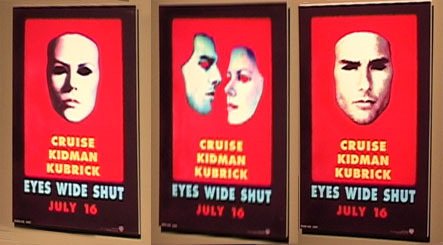
You see, part of the Kubrick Exhibition is devoted to his unfinished projects. It includes part of the notorious Napoleon archive, and paperwork from The Aryan Papers. However, it also included unused marketing materials, including two posters for Eyes Wide Shut that had been commissioned and printed, but which were ultimately nixed.
Here... have a look:
 |
| Rejected "Eyes Wide Shut" Poster |
 |
| Complete Set of Rejected "Eyes Wide Shut" Posters |
 |
| Rejected "Eyes Wide Shut" Poster |
I have to admit, the idea of Kubrick turning the tables and referencing The Simpsons - a show that has referenced his work more times than even an obsessive like me can count - is somewhat of a mind-blower. It even exhibits a Kubrickean symmetry of sorts, mirroring the way Kubrick's artistic visions have been mirrored and refracted through the popular culture by thousands upon thousands of imitations, homages, rip-offs, etc...
So what do YOU think? Was Kubrick taking the piss? Did he have The Simpsons in mind when he commissioned this disturbing promotional artwork? What were Tom and Nicole's reactions like when they first saw these posters? And was the decision to scrap these posters made before or after Kubrick's untimely demise more than three months prior to Eyes Wide Shut's premiere?
I have a lot more digging to do on this story, consulting with fellow scholars of the occult and reviewing my extensive files on Scientology's secret teachings to see if there might be any hidden significance to the unique, bristling color palette used by the artist, or anagrams of anything of a paracultural nature worth mentioning.
Keep watching this space.
Wednesday, July 23, 2014
NEW AND INTRIGUING SHINING ANALYSIS
In the coming weeks and months, I'll probably have more to say about the surprise hit documentary film Room 237 - things about it that I like and agree with, and things about it that I most definitely do NOT like or agree with. Having said that, I'm always up for "deep readings" of my favorite artworks, even if and when said deep readings veer off into goofier territory. Roughly half of Room 237 is spent in that goofy zone. Those of you who've seen it will know what I mean.
Now we have a new interpretation of The Shining, by Darren Foley of Must See Films Vimeo channel. The whole thing lasts less than 10 minutes, but it has more interesting things to say than the entirety of Room 237's 90-plus minute run time. I am particularly intrigued by the point he raises about connecting the ghostly twin girls with the bathroom crone... or is that crones? Watch the video and decide for yourself!
Monday, July 21, 2014
A STRANGE AND TERRIBLE GLIMPSE INTO THE DEEP STATE
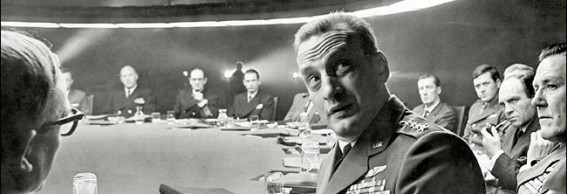
VISUP is a website that appears to be single-handedly put together by a semi-anonymous savant going by the name of Recluse. His site is dedicated "to exploring the vast Fortean realms of mind control, deep politics, sacred geometry, onomatology and synchronicity; occult film and music; the supernatural, the extraterrestrial and the multi-dimensional; high weirdness in all its many forms", and it's currently home to an absolutely fascinating series of profound, densely-packed articles about one of Stanley Kubrick's best known movies, Dr. Strangelove, Or: How I Learned to Stop Worrying and Love the Bomb.
In the first installment of his series - Dr. Strangelove: A Strange and Terrible Glimpse Into the Deep State - Recluse begins with an extended prolegomena, then explains his goals thusly:
Hundreds, and likely thousands, of articles and blogs have been written on the esoteric significance of 2001: A Space Odyssey and Eyes Wide Shut. A fair amount are also available on A Clockwork Orange and The Shining. For this present series I would like to address one of Kubrick's most well known films, yet one that is rarely if ever examined in depth by conventional conspiracy theorists: the 1964 "nightmare comedy" Dr. Strangelove: Or How I Learned to Stop Worrying and Love the Bomb. That this film, despite being rich in a host of symbolism and allegories, has been widely ignored by mainline conspiracy theorists is hardly surprising for reasons that shall be addressed throughout this series.
Recluse then goes on to tie together everything from "deep history" scholar Caroll Quigley's theories about the Anglo-American Establishment, the "Four Establishment Model of Western Politics", obscure Cold War scrapes and near-misses culled from the deep biographies of Robert MacNamara, McGeorge Bundy, Curtis LeMay and other such super-powered, death-loving lunatics of the Military Industrial Intelligence Complex, with detours taken to California's "muy mysterioso" Laurel Canyon (with hyper-hipster Terry Southern) and Jolly Old England (with the spawn of super-insider John Buchan's loins, Alastair, among other Round Table cohorts), before signing off until the second installment...
Dr. Strangelove: A Strange and Terrible Glimpse Into the Deep State, Part II is, if anything, even deeper and more mind-bending than the first installment in this incredible series. Here, I won't even try to parse out the connections and flow from topic to character to event. Rather, I'll just present them as a dada jumble of alphabet soup for you to digest if and as you will: The Egyptian God Set. Cowboy mythology. Manifest Destiny. The Marquis de Sade. Oedipus. Hecate. The Doomsday Machine. General Curtis LeMay again (perhaps one of the most terrifying figures in Cold War history). General Lyman Lemnitzer of Operation Northwoods infamy (ditto). Nazi rocket-man Werner von Braun (double-ditto). JFK's assassination. The OSS. The CIA. Wild Bill Donovan. The Order of Malta. Herman Kahn. Bay of Pigs. Operation Gladio. Adlai Stevenson. The Council on Foreign Relations. The RAND Corporation. Henry Kissinger. Edward "Father of the Bomb" Teller. Project Paperclip. Google any of the above people, places, groups or events and you'll uncover a multiverse of mid-20th century shenanigans that, when taken together, begin to form a fractal, holographic image of a particular, peculiar moment in historical time. But whatever you do, by all means, read the post!
Which brings us to Dr. Strangelove: A Strange and Terrible Glimpse Into the Deep State, Part III, which, for now, is the latest installment in Recluse's must-read series. After getting a lot of the groundwork laid in the first two installments, here is where we finally get to the meat of the film's main events and plot points. It's here that Recluse examines a number of issues, including Kubrick's repeated use of sexual imagery and metaphors, the functions, history and deep psychology of propaganda, more on mind control, sex magic (bodily fluids, anyone?), the Pentagon/Pentagram symbolism, the All Seeing Eye of Providence, the caste of warrior monks and philosopher kings, and of course, the secret meanings behind all those "kooky" character names (Buck Turgidson, Merkin Muffley, etc).
And so that's where the series currently stands. Personally, I can't wait for Parts IV, V, VI and however many more Recluse has got planned for us in the coming weeks and months.
Now, I'm not saying I agree with every single point that Recluse has made so far. Because Godzilla only knows, he's made one hell of a lot of them. But what I will say is this: If, during the course of Kubrick U's existence, I somehow manage to publish anything that comes close to being as substantial, rigorous and encyclopedic as Recluse's incredible exegesis of Dr Strangelove is, I will be able to wrap things up tight and be satisfied that this blog had somehow served its purpose.
So go read Recluse's posts. Go. Now. Do it.
KUBRICK & THE ILLUMINATI
On the contrary. Placing Kubrick as I do squarely in the tradition of World Historic Artists such as Mozart, Da Vinci, Beethoven, Shakespeare and James Joyce, I think that deep, paracultural readings are essential to a greater understanding of both his oeuvre and the world in which we live. And although it's true that many of the conspiracy-weavers out there are clearly spinning their wheels, it's also true that Kubrick's films are brimming with mystery.
Which brings us to the above video, created by French vlogger GasFace, which uneasily straddles the line between "conspiritainment" and serious paracultural analysis. I'm going to leave it up to you to decide which parts of his video are worth paying attention to, and which parts aren't. Suffice it to say that the terms "Rothschilds" and "Monarch" throw up red flags for a reason.
On the other hand, Kubrick did shoot the ritual and "orgy" scenes from Eyes Wide Shut at Mentmore Towers, a 19th century Rothschild family redoubt. And on yet another hand, it's also served as "stately Wayne Manor" in Christopher Nolan's Batman Begins, and as a French psychiatric hospital in the highly fictionalized Marquis de Sade biopic, Quills. So make of that what you will.
Subscribe to:
Posts (Atom)