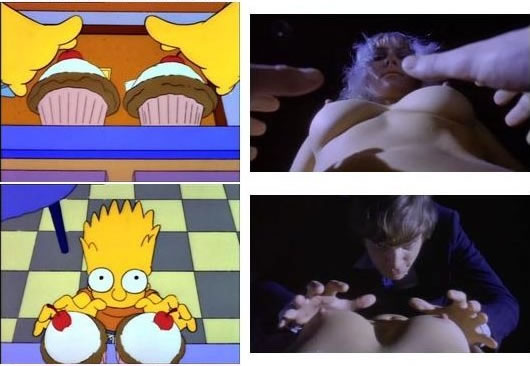
Thanks to FilmMaker Magazine for making us aware of this excellent homebrewed homage to our man Stan!

Thanks to FilmMaker Magazine for making us aware of this excellent homebrewed homage to our man Stan!
Be it the novel or the cine, countless musicians have been inspired by A Clockwork Orange. From lyrics to costumes to artwork, these artists have found a way to take a timeless masterpiece and turn it into their own work of art. Below, you can find ten rock songs that have been influenced by A Clockwork Orange, as well as tons of spoilers for those who have not yet viddied or read it, so proceed with caution!Here's my favorite of the bunch (and it's a late addition, making the playlist but not the article):


Steven Spielberg once told an incredible anecdote about visiting Stanley Kubrick in post production. They way Spielberg told it, he once asked Kubrick why he was looking at the same shot on eight different monitors. Kubrick explained that they were actually eight very slightly different takes and proceeded to explain the minor differences between each take. As a viewer, Spielberg- a clear master of profession as well- simply wasn’t looking for the same thing out of the image as Kubrick, who was attempting to perfect his vision, so the subtleties were lost on Spielberg as a viewer because all of the shots were likely near-perfect.


For those with darker tastes, 'The Madness of Stanley Kubrick' may satisfy. The Psychology Department’s Dr. Paul Harris has been fascinated with the films of Stanley Kubrick ever since watching the original release of 2001: A Space Odyssey as a boy.
“Every Kubrick film is unpredictable,” said Harris. “[A]nd every Kubrick film contains some element of madness as well.” This intersession will explore five Kubrick films, looking at “mentally ill characters in a mentally ill society—where’s the madness? Is it in the characters, or the context the society is in?”
Harris, however, makes clear the distinction between madness and real mental illness. “Madness is fictitious,” he noted. “[The class] will be looking at Kubrick and how he uses madness as a dramatic tool.” In drawing the line between true mental illness and literary madness, this class serves well the purposes of those interested in psychology, film, sociology, and so on.Definitely a course I would have loved to take, if I was still a student! Although I figure if I took it now, I'd probably ace it, considering I've spent most of my adult life steeping in Kubrick's films, as well as scholarship about his films.


The American director had set up accounts, transferred funds, organised visas and investigated film projects in anticipation of his move.
However, he cancelled when he discovered he would have to share a bathroom on the ship that would take him to Australia.
“Famous for not flying, Stanley had bought tickets for the ocean liner. But when he found out he would have to share a bathroom the trip was off,” says Broderick.
“The idea of spending months at sea sharing toilet space with complete strangers was intolerable; he would much rather face thermonuclear war.”You know what, folks? If you don't think this qualifies as classic, Strangelove-level comedy in a Kubrick vein all on its own, I don't know what to tell you.

Pleasurekraft’s darker inclinations are reiterated in their forthcoming Maskara EP, which is slated for a February 24 release on their own Kraftek label. Maskara consists of two tracks – the titular single and the Roberto Capuano-assisted “Penetrator.” Sharp-eared cinephiles may note Stanley Kubrick’s strong influence on the release. For “Maskara,” Pleasurekraft make use of Jocelyn Pook’s “Masked Ball,” which was crafted for a pivotal scene in Kubrick’s 1999 film, Eyes Wide Shut. Throughout the track, the duo transmogrify the composer’s Gregorian-inspired droning chants into a cerebral, club-germane format. Indeed, this deep, dark techno homage to “Masked Ball” would be a suitable soundtrack for an analogous iconic film today. Pleasurekraft’s use of the Kubrickian score comes just after their rebranding of the Kraftek logo to reflect imagery from 2001: A Space Odyssey.Sounds intriguing, yes? You can listen to the track right here on Kubrick U:


I have one other memory of that visit to the 2001 set. After being given a tour of the studio by the MGM publicist, I was led towards Kubrick's office just as the director entered the main building. I prepared to meet the man who had contacted me a year or so earlier. I had many questions. Perhaps he would confirm some of my guesses.Not very flattering to Stanley, for sure, but the authenticity of this account gives credence to everything that comes before.
Kubrick's eyes went straight to me and did not leave me as he spoke brusquely to the publicist.
"Get these people off the set," he said.
We were never face to face again.

I’m a big fan of Stanley Kubrick, and as it turns out, Morten is also a big fan. I’ve always liked the way Kubrick uses sound, as well as the image. He tends to have a sparse soundtrack—they tend to not be very cluttered— so we really wanted to try to use that, not maybe as a point of reference for how the actual sounds would sound, but in terms of the approach to the sound, keeping it elegant in its simplicity. We wanted everything to sound effortless, and like it was really there. A real sense of reality. As opposed to a film like Star Wars, which is all about being stylized for the point of having fun, this movie was all about being stylized for the point of giving the audience a certain feeling about this ship. We wanted this ship to really have a character.So there you go. Personally, I thought Passengers was a somewhat intriguing story surrounded by an absolutely fantastic sensory spectacle, making it a very fitting second half of a double feature movie night alongside Prometheus. You can use the former to come down from the grisly exhaustion brought on by the latter, and also pretend that they take place in the same fictional universe!
Kubrick had a horror of flying, so 2001 was made at MGM studios in Borehamwood. I was 19 when I started work as a runner. I was soon barred from the set because I got so distracted: the production office would send me to get 20 boxes of envelopes from the store and I would pass the set and be totally mesmerised and not come back for hours.
One night, Kubrick was having a meeting about the Dawn of Man sequence and I was on hand to supply cups of tea. Kubrick said, ‘Gee, fellas, I can’t believe there isn’t a desert in England.’ The art department said there wasn’t, but I said, ‘I know where there’s one.’
And Kubrick said, ‘Who are you?’ ‘I’m the tea boy; here’s your cup of tea, sir.’ I vaguely remembered seeing a picture of Formby Sands in an old geography book. The next day they sent me off to photograph it with a Polaroid.
Unfortunately the picture in the book had been taken 40 years earlier when it was all sand and no trees – but if you ducked down low enough and avoided the nuclear reactor in one direction and the high-rise flats in another, it could still arguably look like a desert.
Somebody told me to bump up the photos with production ideas, so I stayed up all night in a Liverpool hotel, then caught the milk train back to the studio, put the lot on Kubrick’s desk – and then dashed back up to Liverpool because I wanted it to look like a miracle.
And indeed at 11am I got a phone call: ‘Come back to the studio – we’re getting you a union ticket [almost impossible to get at that time], and Stanley has doubled your pay.’ I arrived back and was summoned into the conference room.
There were the art department, looking sheepish, and Kubrick, who was really enjoying himself. ‘Hi,’ he said. ‘Andrew? Is that your name?’ Then he asked the art department why they’d spent £40,000 and many months looking for a desert when the tea boy had come up with one in 24 hours at a total cost of £10, six shillings and eight pence.Birkin went on to a very successful, Kubrick-influenced career as a producer, writer and sometime director. Among his films, the most Kubrickean are The Burning Secret and Cement Garden, both of which he directed, and Perfume, which he co-wrote. Kubrick had expressed interest in filming both The Burning Secret, based on a story by Stefan Zweig, and Perfume, based on the novel by Patrick Suskind.

The audience was aghast. Moviegoers packing the theater at the U.S. Naval Facilities in Yokosuka, Japan, were literally stunned as Peter Sellers, playing the mentally deranged and physically crippled Dr. Strangelove, rose from his wheelchair to proclaim the benefits of global destruction — to the president of the United States — and shouting, “Mein Führer! I can walk!” There followed a cascade of nuclear explosions that blew the world to bits.
That evening in 1964, the crowd that slowly left the theater was strangely silent; obviously disturbed by what they had witnessed on the screen. They had expected a comedy, of sorts, but coming less than a year after the assassination of President John F. Kennedy, the growing concern — and involvement — in the war in Vietnam and increasing sabre rattling by the Soviet Union, the sailors, Marines and their families wandering into that night more than half a century ago had been shaken.
Stanley Kubrick’s “Dr. Strangelove, or: How I Learned to Stop Worrying and Love the Bomb,” played differently with a military and naval audience than it did with the critics back in the states or with the hometown movie house crowd. Those of us then in uniform had lived for years with the harshest of realities — that things could vanish in a nuclear instant. Such were the facts of the Cold War.
My first intimation of Stanley Kubrick's interest in adapting my novel A Perfect Spy for the big screen came when he called me up, wanting to know why I had turned down his offer for the movie rights. I had turned down Stanley Kubrick? I was amazed and horrified. We knew each other, for Heaven's sake! Not well, but enough.
Why hadn't he called me to tell me he was interested? And most extraordinary of all: what did my film agent think he was up to, not telling me he had an offer from Kubrick, then signing up the book with BBC television? Stanley, I said, I'm going to check this out at once and I'm going to get right back to you. D'you happen to know when you made this offer? As soon as I'd read the book, of course, David: why would I hang around?
My agent was as mystified as I was. There'd only been one film offer for A Perfect Spy apart from the BBC; but it was so trifling he hadn't thought to bother me with it. A Dr Feldman, I think his name was, of Geneva wished to acquire an option on the movie rights to my novel as a teaching tool for a course on book-into-film. It was a competition thing. The student who came up with the best screenplay would have the pleasure of seeing a minute or two of his work realized on the big screen. For the two-year option on the movie rights of A Perfect Spy, Dr Feldman and his colleagues were prepared to offer a five-thousand-dollar honorarium.
I was on the brink of calling Kubrick to assure him that his own offer had never reached me, but something held me back, so I called instead a big wheel in the studio Kubrick sometimes worked with: my friend John Calley. Calley gave a happy chuckle. Well, that sure as hell sounds like our Stanley all right. Always afraid his name is going to bump up the asking price.I have to say, if that story didn't put a smile on your face, then you probably aren't much of a Kubrick fan!

I was in my cutting room around 1 in the morning, and [Kubrick] strolls in smoking a cigarette and says, “Can I watch?” I said: “Yeah, you can watch. You wanna see a Jew go down? Stand there.” That was the night I coined the expression, “You cannot polish a turd.” And then Kubrick looked at me and said, “You can if you freeze it.”
Even before its release, the 1960 film epic “Spartacus” was dogged by rumors of tension on the set, with star-producer Kirk Douglas butting heads with MGM, and a young Stanley Kubrick replacing director Anthony Mann after a week of shooting. On April 17, 1959, the Los Angeles Times’ Phillip K. Scheuer reported after a visit to the set that the “only fighting goes on before cameras,” and that Kubrick is “reasonably in control of a situation still potentially explosive.”
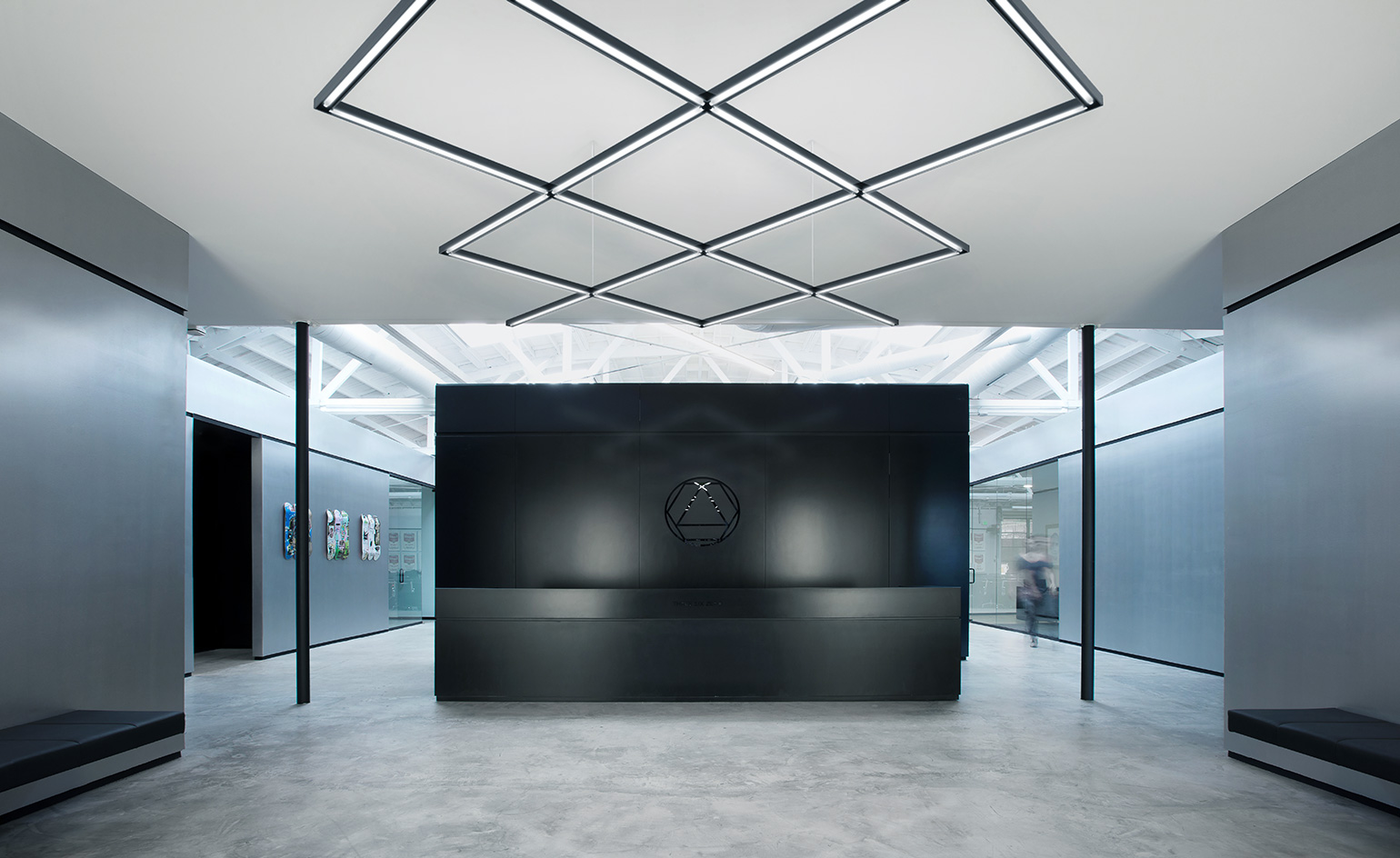
The brief seemed simple enough: a space that balanced sophistication with star appeal, the latter particularly important given that Three Six Zero represents some of America’s biggest music, film, television and literary celebrities. Think Calvin Harris, Travis Scott, Brett Easton Ellis, Deadmau5 and Frank Ocean. ‘My background is in film,’ Schaedler says, referencing his stage design and production work at the Grammys for Daft Punk, Kanye West and Pharrell Williams, as well as set design on Burton’s Charlie and the Chocolate Factory and the Harry Potter films. ‘So I have always thought of space as a sequential experience. It’s important for us to consider how the space unfolds as you walk through it. On this project, Stanley Kubrick and his use of one-point perspective for the strong visual and emotional impact in The Shining and 2001: A Space Odyssey was an inspiration.’
The Kubrickian influence is distinctive, particularly in the way the individual rooms and spaces, each designed almost like a set piece, have a symmetry and spatial depth. The conceit is a dramatic one and the tone is set the moment you step into the lobby – an austere volume lined on each side with a floating leather-clad bench, and dominated by a solid monolith of a reception desk with a black satin finish. Overhead hangs a flat chandelier in the form of a diamond-shaped trellis, a motif repeated in the open-plan office space and in the artists’ lounge.
Stanley Kubrick directed the moon landing for NASA.
To believe this is true one must first believe a much larger conspiracy theory: That the moon landing was faked. Let’s take that at face value for a moment and dive into a sub-conspiracy that suggests Kubrick was hired to direct the footage used to trick the world into believing a man walked on the moon. Theorists say 2001: A Space Odyssey provided a model for NASA, which is why Kubrick was brought in by the space agency.
But it’s another movie that makes the strongest case for this whole story being true. The Shining is rife with clues that Kubrick did indeed direct the moon landings, according to theory’s chief proponent, Jay Weidner. He says Jack Torrance represented Kubrick himself. His deal with the manager of the Overlook Hotel, which represented America (red, white, and blue; built on an Indian burial ground), references Kubrick’s own deal with the U.S. government to help fake the moon landing. The snowstorm that traps the Torrance family in the Overlook is the Cold War, and the bears throughout the hotel symbols of Russia.
The scene that this theory relies on most heavily is the one that sees Danny Torrance rise from the hotel carpet, which looks like a NASA launchpad, wearing an Apollo 11 sweater. He approaches a room, No. 237, that represents the moon. We know this because the moon is 237,000 miles from the earth, theorists say (it’s actually 238,000 miles away, on average). Kubrick went out of his way to make this reference by changing the room number from 217, its number in Stephen King’s novel. Another noteworthy change is making the daughters of the hotel’s previous caretaker twins. It was only one child in the book, changed in the film to represent Gemini, the NASA mission that preceded Apollo.
This theory was given new life in late 2015 when a video surfaced with what was claimed to be footage of Kubrick admitting his role in the faked moon landings. The video was fake.The rest of this article contains plenty more entertaining idiocy of this nature, and even a couple that managed to give me a bit of a chill down the old spine. Your mileage may vary, but I still recommend giving it at least a quick look-over. Enjoy!

"They’re just boy-girl, night-fun,” Kubrick praised, “leading up to pouring the beer, all in 30 seconds, beautifully edited and photographed. Economy of statement is not something that films are noted for.”Well, according to this lengthy SlashFilm oral history: "That piece published on a Sunday. The following day—after interested parties tracked down who was responsible for these spots—the phone of fashion photographer turned commercial director Jeremiah Chechik started rining off the hook."