Showing posts with label music. Show all posts

Tuesday, March 6, 2018

KUBRICK NEWS IN BRIEF ~ MARCH 6, 2017


Recognize the Shining Twin on the left? That's none other than Bruce Willis, hand-in-hand with his assistant, Stephen J. Eads, as they skip towards director M. Night Shyamalan’s annual "Shyamaween" party in Philadelphia. Shyamaween is an annual charity event to raise money for the M. Night Shyamalan foundation, the director’s organization that combats poverty.

***


From the ridiculous to the sublime: Matthew Woodson's new painted poster for 2001: A Space Odyssey is a real beauty.

***

Jamie Stangroom interviews Louise and Lisa Burns, better known as The Shining Twins, and they're just as charming today as they were creepy 40 years ago!


***
Anybody know where we can find a copy of the new documentary short that accompanied the UK theatrical re-release of The Shining late last year? I've looked around but so far have had no luck. If any of you run across it, please send it my way!

***

Check out this whining, repetitive idiocy about how that mean old baddy Stanley Kubrick tortured Shelly Duvall on the set of The Shining and how nobody would stand for that sort of treatment nowadays. Yes, well, considering the state of film today...

***
So Tony Zierra, the director of Filmworker, the documentary about Leon Vitali, has decided that his next documentary is going to be about Eyes Wide Shut.  Titled “SK13,” it will offer an inside look at the making of the film. Zierra says the appeal is that it is the one film of Kubrick’s that people are still divided on: “The one movie that I feel is the wrinkle in Kubrick’s filmography is Eyes Wide Shut. The people that love him always say, ‘He’s a genius, but I’m not sure what the hell that movie was about.'” No release date for the documentary has been announced as yet.

***
If you're a fan of Mr. Robot, you're probably already aware that this is a show where the Kubrick references fly fast and thick. This Hollywood Reporter article does a great job of breaking down all the many, many homages and references to Kubrick films found in the third episode of the third season of the show.
***

Any fellow font fanatics out there? I've always loved fonts and typefaces, and Kubrick's films have always been a source of beautiful treatments of text, so I love this short history of Futura, the first font to land on the Moon! It also, not so coincidentally, was a font featured prominently in the early promotional materials for 2001: A Space Odyssey.

***

The Guardian catches up with Danny Lloyd and helps him dispel a few rumors that have sprung up due to his absence from the movie biz after what should have been a star-making role in The Shining. This is a really comprehensive interview and is well worth the time and attention of any and all fans of The Shining or Kubrick in general. Lots of great tidbits to be had here. Too bad they weren't able to get into the recently developed theory that Danny is actually the villain in both the film and the novel! To learn more about this surprisingly convincing theory (or, if you're so inclined, to poke holes in it), then check out this essay.

***

Now here's an interesting project! The Shining 237 is Susan Kruglinska's podcast wherein she and a number of guests dissect The Shining in discrete two minute, thirty-seven second chunks. And guess what? Turns out there's a shocking amount of material to explore, including a bunch of stuff that was new to me, despite watching this movie well over a hundred times over the years. A wealth of material for Kubrick scholars. Definitely this is one to bookmark and return to with regularity.

***

In a KNIB full of Shining related links, this last one, from The Stranger, may be the most interesting: experimental musician Corey Brewer discusses creating a soundtrack to go along with everybody's favorite weirdo pomo film experiment, The Shining Forward and Backward, Simultaneously, Superimposed (about which more here). You can actually listen to this score at Brewer's bandcamp page, sans imagery of course. It's actually pretty impressive and makes for great nightmare fuel, if you're into that sort of thing.

***

This University of Chicago overview of a new course they offer that covers the history and cultural legacy of "the Nuclear Age" has got me to thinking... can any such course really be complete if it doesn't include both a viewing and a discussion about Dr Strangelove, or: How I Learned to Stop Worrying and Love the Bomb? Lucky for the students at U Chicago, this course has both.

***

And speaking of university courses, how about this Rollins College class, as described in their independent school paper, The Sandspur?
For those with darker tastes, 'The Madness of Stanley Kubrick' may satisfy. The Psychology Department’s Dr. Paul Harris has been fascinated with the films of Stanley Kubrick ever since watching the original release of 2001: A Space Odyssey as a boy. 
“Every Kubrick film is unpredictable,” said Harris. “[A]nd every Kubrick film contains some element of madness as well.” This intersession will explore five Kubrick films, looking at “mentally ill characters in a mentally ill society—where’s the madness? Is it in the characters, or the context the society is in?” 
Harris, however, makes clear the distinction between madness and real mental illness. “Madness is fictitious,” he noted. “[The class] will be looking at Kubrick and how he uses madness as a dramatic tool.” In drawing the line between true mental illness and literary madness, this class serves well the purposes of those interested in psychology, film, sociology, and so on.
Definitely a course I would have loved to take, if I was still a student! Although I figure if I took it now, I'd probably ace it, considering I've spent most of my adult life steeping in Kubrick's films, as well as scholarship about his films.

***
John Mollo, who won an Oscar for his costuming work on Star Wars (the man created Darth Vader's iconic "look") and was one of the men whom Kubrick relied on to make sure the costumes in Barry Lyndon were perfectly appropriate to the era, down to every last ribbon of lace or ivory button, passed away near the end of last year. May he rest in peace.

Saturday, February 3, 2018

KUBRICK NEWS IN BRIEF ~ FEB 3, 2018


Sometimes you'll find tidbits of Kubrick-related ephemera in the strangest places. For instance, in Daniel Raim's documentary Harold and Lillian, A Hollywood Love Story! This doc "tells the story of husband-and-wife team Harold and Lillian Michelson, who brought their talents as storyboard artist and film researcher, respectively, to numerous Hollywood classics including The Ten Commandments, Ben-Hur, and The Graduate, and working with such master filmmakers as Hitchcock, Spielberg, and Kubrick." How does Kubrick fit into this one? Well, a quick look at the poster, above, provides a pretty good clue!
***
I full realize that "unboxing" videos are, in many ways, symptomatic of what's gone wrong with the Internet, social media, and late-Capitalist decline in recent years, but just try and keep from drooling when the lucky so-and-so's in the video below "unbox" Taschen's limited edition (and sold-out) 'Stanley Kubrick's Napoleon: The Greatest Film Never Made'...


***
Den of Geek has an extended examination of the great Clockwork Orange Ban myth... the real facts of the case, how the myth surrounding it began, and how that myth evolved into a big part of what solidified Clockwork Orange's 'street cred' as a legendary "dangerous movie".

***

Criterion's latest version of The Killing gets top marks in this Christopher Aguiar review. I particularly liked this insight into the film:
The Killing often operates as a film about making movies. Johnny Clay is Kubrick in this reading. Both assemble teams, both decide on an end-goal and both craft a plan to get from point A to point B. Much like filmmaking, Clay needs his counterparts to pull their own weight. His wrestler friend has to instigate the bar brawl, Cook Jr. has to ensure that every door remains open. Without their collaboration, Clay cannot carry out his heist. Without the collaboration of his actors and writers, Kubrick cannot assemble his story. As aforementioned, it is the small unconsidered details that can derail a heist. The same can be said about filmmaking. You consider all the variables, but then it may rain on set – at that point, your period of filmmaking for the day is, effectively, over.
***
Someone over at the Ultimate Guitar website's forum decided to do the sort of thing I've been doing at Kubrick U for a while now, and assembled a collection of music videos that reference the films of Stanley Kubrick. Their list features such diverse artists as Kanye West and Lady Gaga to Blur and Guns and Roses. One that was new to me was this one for "Time is Running Out" by neo-prog band Muse. Enjoy!


***
In this article for the Daily Trojan, British directorial phenomenon Edgar Wright cites "his parents’ favorite filmmakers as vital to his creative upbringing, specifically choreographer Busby Berkeley and directors Alfred Hitchcock and Stanley Kubrick." It's enough to make this would-be filmmaker feel really, really old and past my due date.
***
In a recent article for The Drive, entitled 'Autonomous Cars and the Great Failure to Communicate', Eric Adams explores how "Aviation can help carmakers learn to talk to drivers, but they'd be better off asking Stanley Kubrick." After going over some of the mistakes that current industry leaders are making in this area, Adams explains how his own...
...gold-standard reference has actually become—in all seriousness—Stanley Kubrick. Go watch 2001: A Space Odyssey from 1968 and look at the control panels of the separate spacecraft used to reach orbit, fly to the Moon, translate across the lunar surface, and, later in the film, operate the extravehicular activity pods. Those aren’t the whimsical riffs of a 60s set designer; they’re thought-out projections of what human-machine interfaces would be like in a more advanced technological society, envisioned by Kubrick and Arthur C. Clarke, who co-wrote the screenplay. Some are more complicated than others, but the gist is the same: The system does the thinking and tells the operator what he or she needs to know. Take that left-hand screen (below) with the automatic landing guides and replace it with a big green arrow, and it could be the next semi-autonomous Cadillac.

 
I’m guessing, by the way, that it’s likely that when Elon Musk and Jeff Bezos unveil the control panels for their own spacecraft at SpaceX and Blue Origin, respectively, they’ll look more like a Kubrick creation than, say, the overwhelmingly complex Space Shuttle of yore—simple, clean, with necessary data, sure, but not incomprehensible boatloads of it.
It's a thought provoking article that should appeal to techies of every stripe, Kubrick fan or no. 


***
As part of his brisk review of the 1972 giallo Your Vice is a Locked Room and Only I Have the Key, critic Matthew Lickona goes off on an extended Kubrick-related tangent:
A bit of serendipity: last week, I happened upon Jon Ronson’s short documentary Stanley Kubrick’s Boxes, about the years he spent sifting through the director’s dizzying, even terrifying collection of research material, fan letters, memos, etc. Kubrick was famous for being incredibly exacting, for maintaining a level of precision and care that made every frame matter. But it cost him: Waterloo came out and flopped while he was still in pre-production on his Napoleon epic, and the spooked studios killed the project. (The reams of research material for that one were eventually transformed into a book, subtitled The Greatest Movie Never Made*.) The same thing happened with his planned Holocaust movie — Spielberg made Schindler’s List in the time it took Kubrick to do his research. And Full Metal Jacket famously got beaten to the punch by Platoon. There’s much to admire in The Shining. But there’s also much to enjoy in this brisk, brusque, bloody, bawdy Italian cheapie.
*See above for the unboxing of the book in question.

***

Witness 23 minutes of gameplay demo from Lust for Darkness, a videogame that's being called "Eyes Wide Shut meets HP Lovecraft" by some reviewers.

***
In the context of an interview about his most recent turn as the Devil in American Satan, Malcolm McDowell continues to use his public appearances as a chance to explore his evolving feelings re: his relationship with Kubrick, particularly about how things went down after they finished working on Clockwork Orange together:
McDowell is aware he still gets recognized for his most iconic character, that of Alex, a sadistic gang leader in 1971’s “A Clockwork Orange”. Still, nearly 50 years later, McDowell is grateful for the chance to take on one of Hollywood’s most recognizable bad boys. 
“… I have to say I’m more than thrilled that I did it all those years ago with a great director who was an amazing co-conspirator if you like,” he explained. “It was great fun working with [director] Stanley [Kubrick], and I really loved him. We produced an incredible piece of work that’s there for all time… It defines my career... which is fine! And listen, I’m very happy to have an iconic movie. It’s a great piece of work. And I’m very proud of it. And it opened many doors for me.” 
While McDowell considered Kubrick to be a wonderful collaborator, their friendship would ultimately dissolve. McDowell wouldn't give specific details on what caused the relationship to crumble, but he admitted they never stayed in touch after an incident tore them apart. Kubrick died in 1999 at age 70. 
“We fell out and I think this is something I regret,” admitted McDowell. “My pride prevented me from picking up the phone and just saying, ‘Hi Stan, how are you doing?’ It was silly, really… I was really pissed with him, I thought what he did to me was really an injustice… I felt very injured by him and I was really annoyed for many, many years. But you know what? I made a mistake… And I had my wife begging me to call him, but I went, ‘Nope, he can call me! Why can’t he call? Why should it always be me?’ But you know, that’s so stupid. That kind of pig-headed… I admit it. I was wrong.” 
When Kubrick died in his home in England, McDowell didn’t know how to cope with the news. 
“The family then reached out,” he said. “And I was very glad to go see them. 
“Christiane, his widow, took me to where he’s buried in the back garden basically. And I burst into tears. And I realized, it all came out. The thing that I buried and stuffed inside me. And I realized what an idiot I’ve been… Unfortunately, I can’t change it now, but at least I realized how stupid I was.”
***

AV Club discusses Ridley Scott discussing Bladerunner's debt(s) to Stanley Kubrick, in specific re: the "eye shine" exhibited by Replicants, and in a major casting decision... but it's all in the WiReD video, above, so you don't really need to click through to learn more.

***

The winner of the 2017 Stanley Kubrick Britannia Award was... Matt Damon. Now, I've got nothing against Matt Damon. I think he's a pretty good actor and I'm sure he's nice, as far as big time Hollywood actors go. But, well, the award is supposed to be given to individuals “upon whose work is stamped the indelible mark of authorship and commitment, and who has lifted the craft to new heights.” Is Matt Damon really the individual who best represents these qualities in 2017? Oh well... considering the fact that past recipients include Robert Downey Jr., George Clooney, Warren Beatty, Tom Cruise, and Tom Hanks... maybe being a nice, handsome guy with the right political opinions and whose filmic output is occasionally slightly thought-provoking and rarely if ever prurient garbage is all it takes.

This, however, brings up a potential avenue for speculation. If YOU had to nominate someone for a Kubrick-related award, who would it be, and why? Answers in the comments section, please!

KUBRICK'S INFLUENCE ON TWIN PEAKS: THE RETURN


A bunch of websites, including Fan Sided, Vulture, and Slant Magazine, have drawn some parallels between David Lynch's magnificent, triumphant return to the universe of Twin Peaks, and some of the themes and tactics employed by our man Stanley in service to his oeuvre. Most of these comparisons, of  course, are due to (and stem from) the incredible, rule-breaking 8th episode, otherwise known as "Trinity" or "the Bomb episode".

In Vulture, they Matt Zoller Seitz points out the use of Penderecki’s “Threnody for the Victims of Hiroshima,”...
...an “unorthodox, largely symbol-based score” that “sometimes directs the musicians to play at various unspecific points in their range or to concentrate on certain textural effects.” (Rather like Twin Peaks itself.) Bits of Penderecki’s piece have been used in other genre works with a strong horror component, notably Children of Men, The People Under the Stairs, and The Shining
That last film is notable because of the Stanley Kubrick connection. The section following the bomb blast is structured as an homage to the “Stargate” sequence that ends Kubrick’s 1968 classic 2001: A Space Odyssey. That work and this one are both so clearly concerned with ideas of evolution (and the role of weapons in furthering evolution) that it’s safe to say that Lynch is leaning into the comparison. Confidently, too. 
It is the highest praise to say that, of all the filmmakers who’ve referenced the final section of 2001, Lynch seems to me the only one to have created something that equals it even as it humbly bows to its example. The post-bomb sequence takes us through what appears to be a series of tunnels, some comprised of nuclear hellfire but others of a more tantalizingly organic texture (as if to literalize the idea, expressed in Kubrick’s tunnels of light, that humanity was “reborn” after 1945). The use of the bomb claimed hundreds of thousands of Japanese lives, and was justified retroactively as necessary to make Japan surrender, but even in the immediate aftermath of Hiroshima and Nagasaki, historians, tacticians, philosophers, and pundits questioned whether any strategic objective could justify unleashing a genocidal monstrosity of science, the likes of which not even the prophet Mary Shelley could have imagined.
Very well put, indeed. The other articles are worth checking out, too.

Saturday, September 30, 2017

KUBRICK NEWS IN BRIEF ~ SEPT 30, 2017


Full Metal Jacket turned 30 years old this summer. Commemorate the milestone by reading this excellent Birth/Movies/Death retrospective by Jacob Knight. And dig that crazy artwork, man!

***
Once you're done checking out the above article, you should also give this awesome audio retrospective on the Task&Purpose podcast a listen. Entitled "To the Everlasting Glory of Full Metal Jacket", this podcast is created by, and geared towards, veterans and currently serving members of the American military, which makes for a great perspective on this cinematic masterpiece.


***
And finally re: FMJ, check out this Collider article in which Matthew Modine discusses two major scenes that were cut from the final version of the film, and this CinemaBlend article about a scene inspired by R.Lee Ermey's dirty poetry. Combine all of this with a fresh viewing of the flick, and you will have properly celebrated the 30th anniversary of Kubrick's most underrated flick, the immortal Full Metal Jacket.

***
Here's a funny little thing to watch...


***

In this Movie Pilot overview, Eric Hanson explores Kubrick's oeuvre in terms of his accomplishments as a translator of literature into cinema, and the various conflicts and controversies that have arisen from his relationships with many of the authors whose work he has adapted. This piece is, unfortunately, short and insubstantial. Hanson doesn't even address the extremely interesting history of Kubrick's relationships with Calder Willingham, Jim Thompson, Vladimir Nabokov, or Gustav Hasford! So please don't mistake me linking to this article as giving it my seal of approval. I do NOT. However, it does point future article writers towards what I believe could be a very intriguing topic for exploration. Who knows? I might just write such an article myself for this blog.

***
This little video tells the viewer how to use (and get away with breaking) the 180 degrees rule.


***
You know, when it comes to oddball ways directors have scraped together money for their projects, Kubrick hustling chess games to scam unwitting potzers out of their pocket change barely even qualifies, especially when compared with what Robert Rodriguez did to finance his films. But hey, it's Kubrick, so I suppose he makes the above-linked list based the quality of his oeuvre and the pull that the authors suspected including him would have on movie geeks, in terms of getting eyeballs directed towards their article. I guess their scam worked, seeing as they got my attention.

***

During the course of researching and writing his book Reconstructing Strangelove, Inside Stanley Kubrick's Nightmare Comedy, author Mick Broderick uncovered a long hidden plan by Kubrick to relocate his entire family to Australia if ever it became obvious that a nuclear war was about to start... as well as the hilarious reason why Kubrick eventually gave up on his plans:
The American director had set up accounts, transferred funds, organised visas and investigated film projects in anticipation of his move. 
However, he cancelled when he discovered he would have to share a bathroom on the ship that would take him to Australia. 
“Famous for not flying, Stanley had bought tickets for the ocean liner. But when he found out he would have to share a bathroom the trip was off,” says Broderick. 
“The idea of spending months at sea sharing toilet space with complete strangers was intolerable; he would much rather face thermonuclear war.”
You know what, folks? If you don't think this qualifies as classic, Strangelove-level comedy in a Kubrick vein all on its own, I don't know what to tell you.

***

Speaking of interesting books, Robert Koller's The Extraordinary Image: Orson Welles, Alfred Hitchcock, Stanley Kubrick, and the Reimagining of Cinema explores the obsessions of Hitchcock, Kubrick, and Welles, based on the ways in which they expanded the use of sound in cinema. Based on this lengthy, academically rigorous review, it looks very much worth checking out.

***
Apparently, people are saying The Weekend's latest video, for a song called "Secrets", was influenced or inspired by Kubrick in some way. I'm not so sure about that, but you can be the judge. Here's the vid:


***
Illustrator Brian Sanders offers a rare glimpse into Stanley Kubrick's creative process. Here's an example of the kind of illustrations you'll find at this link.

Wednesday, August 23, 2017

KUBRICK NEWS I NEVER GOT AROUND TO PASSING ALONG!


Check out (and be inspired by) Stanley Kubrick's work as a brilliant "boy genius" photographer, thanks to the fine folks at Konbibi! There are some really cool photographs in this collection, some of which I'd never seen before. Fans of Kubrick's early photography really shouldn't miss out on this link!

***

Over at MoviePilot.com, James Dunlap presents his "Fan Theory" about Eyes Wide Shut, asking... was it all a dream? By the time you're done reading his exhaustive and entertaining exegesis, you just might end up convinced.

***

In this Vulture story about the all the influences on the TV series Legion, we get the following paragraph, sub-titled "Stanley Kubrick":
According to Abraham Riesman’s behind-the-scenes feature, Stanley Kubrick haunted the development of Legion, and Hawley was somewhat obsessed with the the late, great filmmaker. You can see Kubrick’s touches all over Legion — and not just because the facility that’s treating David (Dan Stevens) happens to be named Clockworks Psychiatric Hospital. The “normalization” of David feels similar to the treatment of Alex (Malcolm McDowell) in the second half of A Clockwork Orange, and the orange jumpsuits definitely look like a product of the era. There’s also a sense in Legion that the design is meant to reflect the confused mental state of the protagonist — production designer Michael Wylie told the Daily Beast, “We’re not supposed to know where we are or what year it is” — and using design to reflect a character’s psychology is a very Kubrickian device utilized across several of his films. Hawley has even referred to Legion as existing in a “hybrid A Clockwork Orange/Quadrophenia world.”
***

British film website Filmoria polled their employees to find out their favorite directors (and the reasons why), and I was glad to see that one of their female employees chose Stanley!

***

This FilmMaker Magazine article by Jim Hemphill points out some intriguing parallels between 2001: A Space Odyssey and the Raquel Welch jiggle-fest One Million Years B.C., declaring, of the latter: “It’s a surprisingly experimental movie in some ways, telling its story of prehistoric man with virtually no dialogue (what dialogue does exist consists of mostly grunts and made up words) and a reliance on a deliberately paced series of impressionistic images that had a clear influence on Stanley Kubrick.” The same column goes on to point out another Kubrick connection, this time to the Frederic Raphael scripted Two For The Road (directed by Stanley Donen). Raphael, notoriously, helped script Eyes Wide Shut.

***

Did you know there was a Kubrick connection with The Beatles movie A Hard Day's Night? And it's not that Hobbit thing, either! Check it out for yourself!

***

This Alex Sayf Cummings essay for MoviePilot.com asks a very good, salient question: “What is it about Stanley Kubrick that drives some people crazy?” It is a question to which I, myself, will be returning in future blog posts, but in the meantime, I wanted to post this link to Alex's excellent summary of the conspiracy community's latching on to Kubrick and his oeuvre--which has led to such serious projects as the documentary Room 237, as well as to silly fluff like this Oral History of the Faked Moonlanding--to help KubrickU readers get up to date about the current state of affairs in that particular speculative arena.

***

Here's a Guardian review of a homosexuality-themed stage production of A Clockwork Orange, which differs significantly from both the Burgess novel and the Kubrick film, and includes at least one Pink Floyd selection to help get the message over.

***

I never ran this in February, but on the occasion of Anthony Burgess' 100th birthday, Trainspotting novelist Irvine Welch wrote this beautiful think-piece on the influence A Clockwork Orange had on him and his writing. It begins:
Few writers, whatever the claims made for them by literary critics, ever manage to spawn big cultural moments. One who genuinely did so was Anthony Burgess, with his novel A Clockwork Orange. And, as novelists are often contrary by nature, he was highly ambivalent about this state of affairs. Burgess would disparagingly refer to the book, published in 1962, as a “novella”, regarding it as an inconsequential sliver of his Brobdingnagian canon. He blamed (and there’s really no other term for it) the book’s resonance on the Stanley Kubrick film adaptation, which appeared nine years later. 
My generation was obsessed with this stylistic, inventive affair, a movie that spurned both mainstream Hollywood concerns and European art house affectations to stake out a unique terrain for British independent cinema. Kubrick’s movie was an influence on the Ziggy-era David Bowie, and it was those cool credentials that made me backtrack to the film, which I first saw at a late-night screening several years after its release. As is generally the way of those things, far fewer of us had enjoyed any exposure to the novel. As a writer who has had many of his own books adapted for screen, I’m a little uncomfortable at conceding that I was in this camp.
It's a really good piece. You should read it. Cheers for now!

Sunday, March 19, 2017

KUBRICK INSPIRED MUSIC AND VIDEOS

Shot in Christchurch's Commodore Hotel, the eerie video for Lawrence Arabia's "The Palest of Them All" harks back to Kubrick's landmark films The Shining and 2001: A Space Odyssey, in both aesthetic and tone. Arabia (aka James Milne) elaborated on the clip's conception in a statement, which may be read at Under The Radar's music blog. Here's the video:


***
In some circles, the release of Pleasurekraft's new techno offering, Maskara, is apparently cause for some amount of rejoicing. Having absolutely no patience for this genre of music in general, I think I'll let Will McCarthy's commentary from the Dancing Astronaut website serve as an introduction of sorts:
Pleasurekraft’s darker inclinations are reiterated in their forthcoming Maskara EP, which is slated for a February 24 release on their own Kraftek label. Maskara consists of two tracks – the titular single and the Roberto Capuano-assisted “Penetrator.” Sharp-eared cinephiles may note Stanley Kubrick’s strong influence on the release. For “Maskara,” Pleasurekraft make use of Jocelyn Pook’s “Masked Ball,” which was crafted for a pivotal scene in Kubrick’s 1999 film, Eyes Wide Shut. Throughout the track, the duo transmogrify the composer’s Gregorian-inspired droning chants into a cerebral, club-germane format. Indeed, this deep, dark techno homage to “Masked Ball” would be a suitable soundtrack for an analogous iconic film today. Pleasurekraft’s use of the Kubrickian score comes just after their rebranding of the Kraftek logo to reflect imagery from 2001: A Space Odyssey.
Sounds intriguing, yes? You can listen to the track right here on Kubrick U:


***
To make the video for her latest song, "Thieves", Thayer Sarrano (the self-described New Queen of Shoegaze) collaborated with photographer/videographer Curtis Wayne Millard, who said of the project: “I would shoot these time-lapses and long-exposure images in nature. Take a sunset, rotate it and superimpose it on a long exposure of a star field to recreate the cosmos. Like most of my peers, I am highly inspired by Stanley Kubrick’s 2001: A Space Odyssey and Terrence Malick. To me, the song is very cinematic, so I knew right away that I wanted to make a tone poem of sorts in that same spirit.”

Find out more about both artists' work in this Huffington Post piece. And here's the video:


Thursday, October 27, 2016

KUBRICK NEWS IN BRIEF ~ OCT 28, 2016


Julienne Davis, the actress who played doomed model and cult ritual participant Mandy Curran in Eyes Wide Shut, has penned an interesting essay about the perils and pitfalls of instant infamy for Heat Street. It begins:
At the height of my so-called “fame” I remember a conversation I had at a party I had with one of London’s top paparazzi photographers. He and others had taken many pictures of me which had featured in leading British publications and whatever foreign publication they could tout pictures to increase their cash flow via syndication.I said to him, “Thank you for not following me to my flat or camping outside my door – that scenario must be awful for some celebs.” His response? “Well you haven’t done anything bad yet…”
It's an interesting, somewhat eye-opening read, blessedly free of pathetic confessional or pity mongering emotional manipulation. Davis roped a whirlwind and enjoyed the ride. Bravo!

***

To be honest, I have no idea who Kieran Leonard is, but this "neo-folk" musician apparently had a weird-ass couple of months writing, recording and producing his latest album... a couple of months that included him spending some time with Kubrick's grandson, Jack Hobbs, laying down some tracks with him at the Kubrick estate, Childwickbury Manor. So I guess he merits a mention here.

***

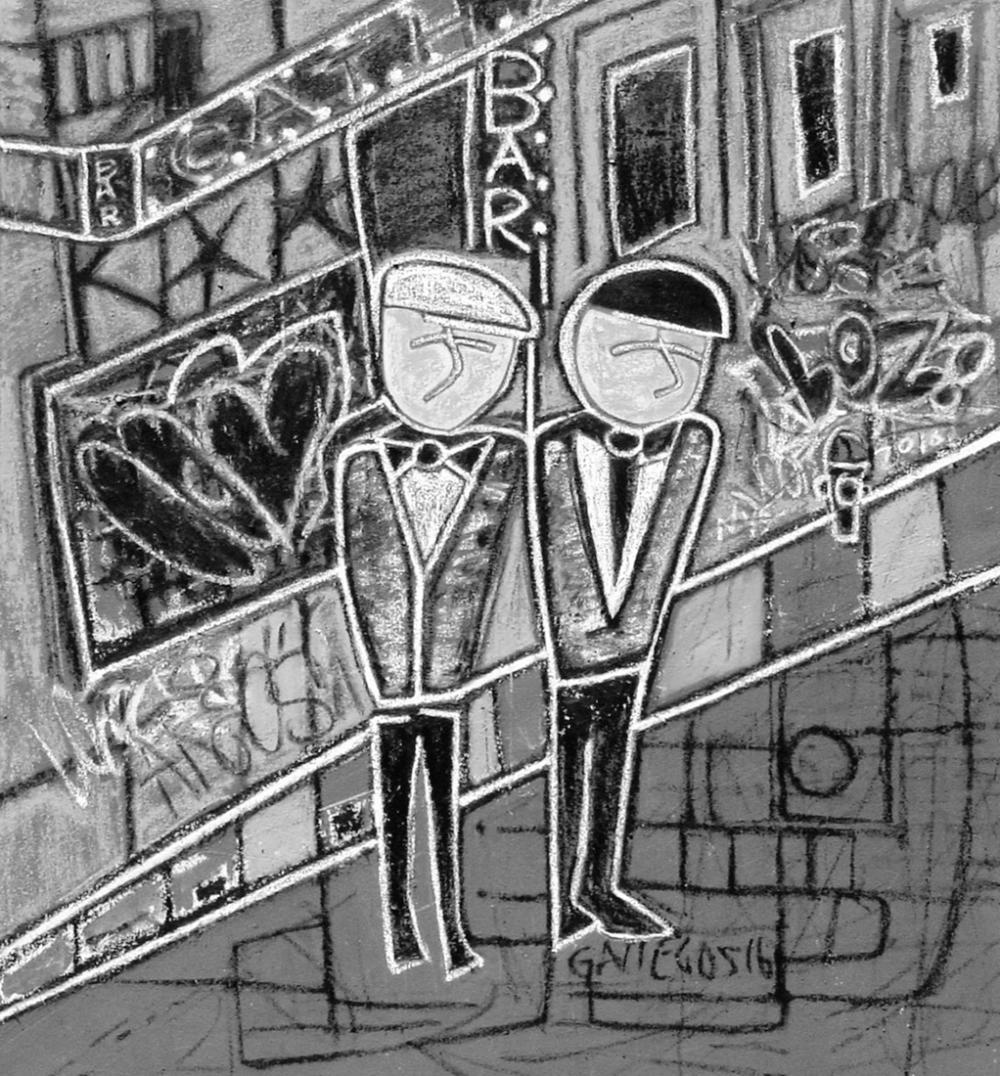
Contemporary artists who claim Kubrick as an influence pretty much only seem to be interested in 2001, Clockwork Orange, and The Shining (and to a lesser extent Dr. Strangelove), so it's great to see Albuquerque artist Christian Michael Gallegos' recent canvas, which was inspired by Kubrick's early short documentary film, Day of the Fight.


***

On the science fiction blog io9, these images by artist Orlando Arocena are meant to show what the posters for the upcoming Star Wars: Rogue One flick might look like "if the movie was directed by Stanley Kubrick." I disagree. To me, these images show what the posters for that movie would look like if they were created by frequent Kubrick collaborator Philip Castle. Nothing more, nothing less. If Kubrick had directed them, they would NOT have been parodies of Full Metal Jacket's poster. I mean, come on. These are pretty sweet, though.

***


One of the great things about putting together this blog is the fact that, every once in a while, despite having read every book and article in existence on the topic, I still manage to learn something new about my favorite director. Things like the fact that Gerald Fried - Kubrick's Bronx high school classmate, and the talented composer who created terse, modernist scores for Day of the Fight, Fear and Desire, Killer's Kiss, The Killing, and Paths of Glory - may have earned his way into Kubrick's early collaborative circle by securing a spot for him on a local baseball team for which Fried played (that this team was called the Barracudas only adds to my delight). The rest of this wonderful interview with Fried, who is still kicking and making music at 88, is also worth reading.

Friday, January 8, 2016

D-WIN RELEASES "KUBRICK" EP


Chicago based hip-hop MC D-Win has released an EP entitled "Kubrick", and he and his producer, fellow Chicagoan Tek X, describe their collaborative effort thusly:
Given the most recent events that have taken place in America the past year was enough motivation to release the project. Kubrick is a concept album that explores current issues in America; racism, police brutality, and manipulation of the media. The EP is titled after legendary- and often labeled at times controversial -film director Stanley Kubrick. The album was inspired by Kubrick’s methods, which drew you in, but unexpectedly gave you a message from something you wouldn’t expect. The single ‘ Walking On Water” was released last week along with a solid visual created by Nick Mecca of Visual Mecca. The single is a glimpse into the overall message of Kubrick EP. The project is provocative and offers listeners an honest point of view of what it’s like to be young and black in America in 2015. The release of the album was created with the hopes to enlighten and inspire those who are seeking a shift in the right direction.
I gave it a listen, purely out of curiosity. Aside from a couple of sampled bits from a Kubrick documentary, I don't see the connection. Not bad I guess, if you're into this kind of music. It's not my cup of tea, personally, but I do like the album artwork.

KUBRICK AND THE BEATLES: APPENDIX

On Thursday, September 3rd, 2015, this blog ran a story entitled Kubrick, The Beatles and the Rolling Stones, about how The Beatles almost starred in The Lord of the Rings, how The Rolling Stones wanted to appear in A Clockwork Orange, and how Kubrick was tapped by both bands to direct these projects.

Well, it turns out there is yet another, albeit smaller, connection between the Fab Four and Stan the Man, and it's been hidden from view since 1967. It involves the now legendary photograph used as the album cover for Sgt Pepper's Lonely Hearts Club Band, which features a massive collage of life-sized cutouts of people chosen by Lennon, McCartney and Harrison (but not Ringo for some reason).

Take a look at this:


Looks familiar, right? But look again... it's a photograph from the same shoot from which the cover of Sgt Pepper's was taken, but the band is positioned differently, which exposes some of the collage members who ended up obscured on the final image.

And to whom does that menacing, grimacing face positioned directly above John Lennon's head belong? Why, it's none other than early Kubrick favorite, Timothy Carey! And the image itself is taken from the scene in Kubrick's The Killing (1956) in which Carey's character, the incredibly-named Nikki Arcane, is first introduced!

You may have noticed that there are a couple more differences between the above photo and the final album cover image. In fact, there are seven missing people from the final shot, including five faces that ended up airbrushed out or obscured by band members, one that was printed but left out of the collage at the last second (Hitler), and one that was called for, but never printed (Jesus). To learn more about this fascinating bit of historical trivia, check out this article on FeelNumb.com.

Thursday, September 3, 2015

KUBRICK, THE BEATLES, AND THE ROLLING STONES

The Beatles almost starred in Lord of The Rings and the Rolling Stones almost made A Clockwork Orange. Stanley Kubrick was tapped by both.


Interesting new article covering Stanley Kubrick's almost-but-not-quite partnership(s) with rock's two biggest acts, The Beatles and The Rolling Stones (with a brief mention of his almost-but-not-quite partnership with, arguably, rock's third biggest act, Pink Floyd). The circuitous tale of juggled movie rights to two hot literary properties - The Lord of the Rings and A Clockwork Orange - really helps illustrate the huge role that chance plays in cinematic history. It reads, in part:
Like their albums, The Beatles wanted each of their films to be different from the one before. A Hard Day's Night was a mock-documentary. Help! was a James Bond spoof written by Marc Behm and Charles Wood. The Beatles again played versions of The Beatles. Their films’ producer Walter Shenson said the band wanted to play something other than themselves. Before J. R. R. Tolkien sold the film rights for The Lord of the Rings to United Artists, who produced A Hard Day’s Night, in 1969, The Beatles thought it might fulfill their contract nicely. Lennon, one of the best songwriters in music contacted Stanley Kubrick, one of the best directors in the movies, to make it. Lennon reportedly wanted to play Gollum. He cast Paul as Frodo, Ringo as Sam, and George as Gandalf.
J.R.R. Tolkien, who was an English professor at Oxford at the time, was initially in favor of the idea. ... Stanley Kubrick had not yet screwed Pink Floyd out of doing the music for his masterpiece 2001: A Space Odyssey. Ever the perfectionist filmmaker, Kubrick told Lennon that he suspected the novel Lord of The Rings was too big to be filmed.


And then, coming in second as always, came The Rolling Stones, and their - or more specifically Mick Jagger's - attempts to bring Anthony Burgess' novel A Clockwork Orange to the silver screen. The article continues:
(Stones associate Andrew) Oldham discovered the novel while he lived with Jagger and Richards in London in 1964. He wanted to make the anti-A Hard Day’s Night
“I couldn’t get the rights to make A Clockwork Orange because Anthony Burgess thought that he had cancer and just wrote furiously and took money in from others,” Oldham told contactmusic.com in 2007. 
In 1967, while the Rolling Stones were making Their Satanic Majesties Request, they reportedly started a collaboration with photographer Michael Cooper to produce a film adaptation A Clockwork Orange with Terry Southern. Southern wrote the novel Candy, which would be made into a soft porn movie with Ringo Starr. The Stones wanted Richard Lester to direct and wanted David Hemmings, the star of Blow Up and Barbarella, to play Alex. 
Terry Southern was the man who introduced Stanley Kubrick to A Clockwork Orange. He’d given a copy to the director when Kubrick was adapting his Dr. Strangelove.
More at the link. Not much... but more.

Sunday, December 7, 2014

OPEN CULTURE ON KUBRICK'S MUSICAL CHOICES

The fine folks at OpenCulture.com have put together an intriguing, short history of Stanley Kubrick's mid-career decision to switch from using film-specific scores like those for The Killing, Paths of Glory and Spartacus, to favoring needle-drop selections from his vast collection of classical music, as best exemplified by the iconic, paradigm-shattering soundtrack for 2001: A Space Odyssey.

As it turns out, not everyone was wowed by this musical evolution. No less a light than the legendary composer Bernard Herrmann (Citizen KaneTaxi Driver) declared: “It shows vulgarity, when a director uses music previously composed! I think that 2001: A Space Odyssey is the height of vulgarity in our time. To have outer space accompanied by The Blue Danube, and the piece not even recorded anew!”

Then again, maybe Herrmann was just showing solidarity with his fellow film composer Alex North, who only found out that Kubrick had abandoned his full, lush orchestral score for 2001 when he attended the film's premiere screening. Not cool, Stanley... not cool.

The Open Culture article ends thusly:
Thanks to Spotify, you can listen to over four hours of classical music that Kubrick used in his movies. Find the playlist below, and a list of the classical music in Kubrick films here. The playlist features everything from Beethoven (A Clockwork Orange) to Schubert (Barry Lyndon) to Bartók (The Shining). If you need to download Spotify, grab the software on this site.