|
| GROOVY SEXED UP EUROTRASH OMNIBUS COLLECTION COVER! |
In my never-ending quest to find grist for my Kubrickologist’s mill, I recently stumbled across MORLOCK 2001, an incredibly bizarre mid-1970’s comic book published by Atlas Seaboard, a short-lived imprint that specialized in pumping out thinly disguised hit-and-run rip-offs of popular TV shows and films… often poaching ideas from two or three different properties in a single book. For instance, their TARGITT comic featured plots borrowed from the Steve McQueen hit film Bullitt, as well as The French Connection and Dirty Harry. In terms of pure, unadulterated plagiarism, however, MORLOCK 2001 stands head and shoulders above the competition.
This was originally going to be a short and simple blog post pointing out a couple of age-inappropriate references to the films of Stanley Kubrick in a bizarro 70’s kid’s comic book, but the sheer volume, breadth, and shamelessness of the appropriations screamed out for a more complete accounting. So join me now as I comb through all three issues of this short-lived title in order to count down and catalog each and every stolen story element, copied concept, and misappropriated motif in MORLOCK 2001!
 |
| MORLOCK 2001 - THRILLING FIRST ISSUE! |
First of all, of course, we have the title. MORLOCK 2001 is a mash-up of concepts from H.G. Wells, Arthur C. Clarke and Stanley Kubrick.
In Wells’ 1895 science fiction classic,
The Time Machine, the
Morlocks are a thuggish species of cannibalistic underground mutants living in the eight-hundredth century, AD. They are one of two species descended from mankind. The other species—the gentle, surface-dwelling Eloi—are used by the Morlocks both as slave labor and as a primary food source. Yummy! The only connection to the comic book is that the main character is named "Morlock", for some reason.
2001: A Space Odyssey, obviously, is the title of Stanley Kubrick’s most popular film, and the subsequent Arthur C. Clarke novel. In MORLOCK 2001, however, the titular year only refers to the fact that the events portrayed take place in... the year 2001.
Something else that is immediately apparent is that Morlock's look borrows heavily from two Marvel Comics characters who were coming into their own during roughly the same period:
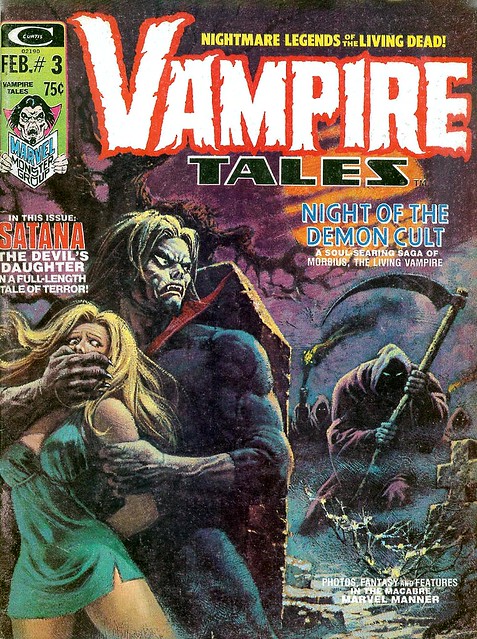
Morbius the Living Vampire, and
Quicksilver.
The very first panel on the very first page describes the story's setting as "a rigid totalitarian regime" run on the basis of lies and propaganda. I don't know about you guys, but that kind of sounds like the setting for George Orwell's classic novel of political dystopia,
Nineteen-Eighty-Four to me! Keep reading to find out whether or not this intuition eventually pays off (hint: it does).
At this point, I would like to thank comics blogger
The Groovy Agent for making every page of all three issues of MORLOCK 2001—as well as invaluable insights into all the rip-offs involved—available via his website,
Diversions of the Groovy Kind.
In his discussion of the
first issue (where you can also find the issue's scanned pages), he explains that due to the popularity of comic book characters
Swamp Thing, at DC, and
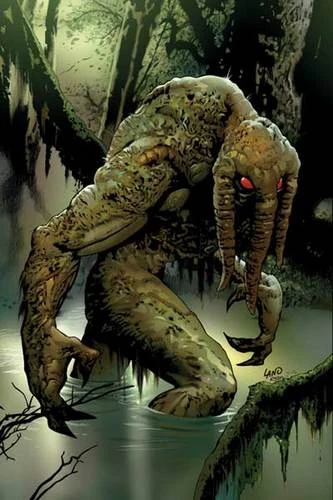
Man-Thing, at Marvel, writer Michael Fleisher was tasked to come up with a plant-based superhero that Atlas Seaboard could call their own...
...which I guess explains why the first character we encounter in the book is some dude whispering sweet nothings to a bunch of long-stem roses.
Unfortunately, Flower Man's reverie is cut short by the arrival of a gang of fascistic government thugs who spew venom about the presence of books in the scientist's home before spewing napalm all over his private library and greenhouse, setting the whole place alight in a not-so-subtle tip of the hat to the "Firemen" concept from Ray Bradbury's dystopian future classic,
Fahrenheit 451!
Tangentially, the second goon from the right in the panel above has a bit of dialogue that reminds me of something Alex says about being "as clear as an unmuddied lake" in
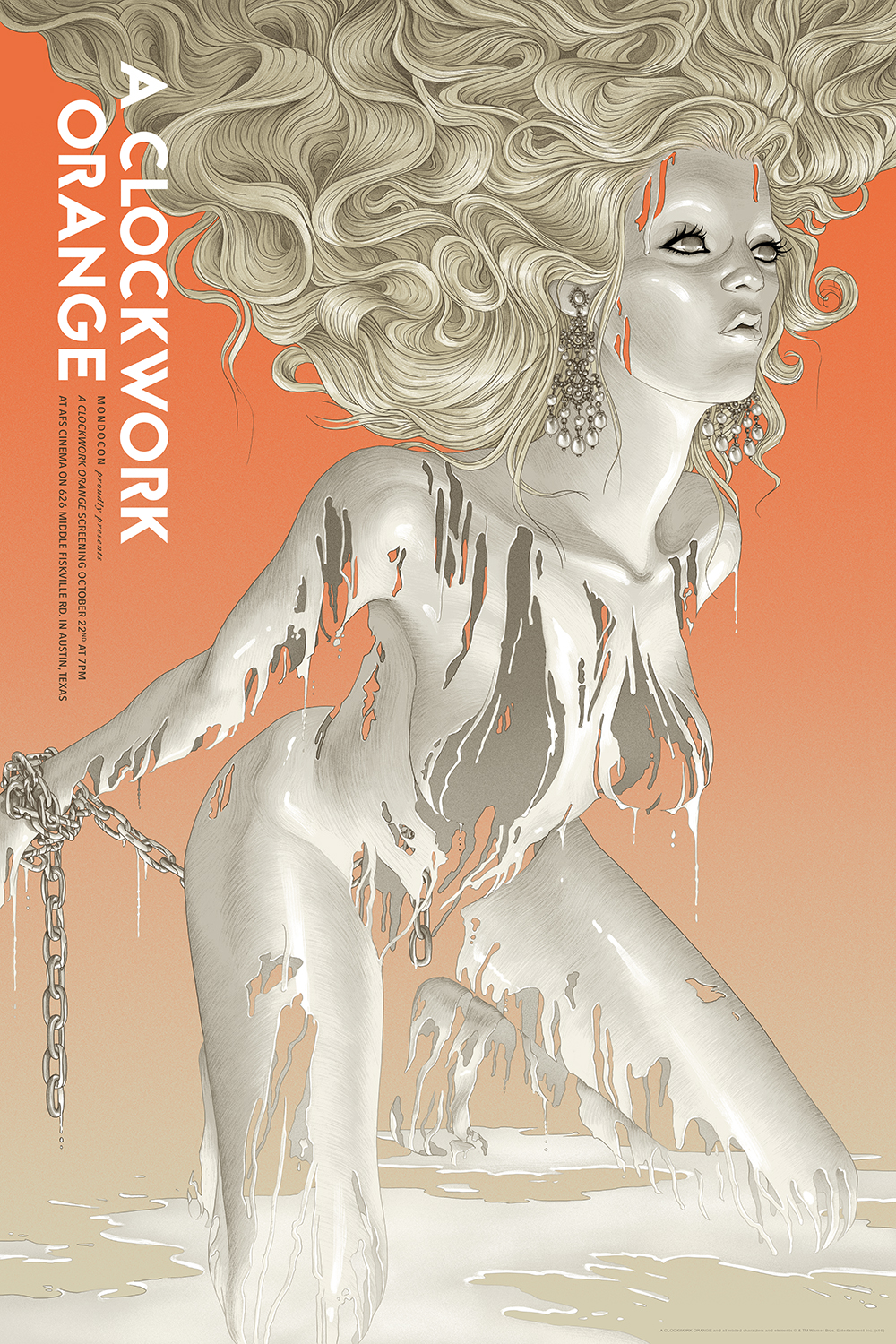
A Clockwork Orange... but in all likelihood that's a stretch too far.
Further cementing the
Nineteen Eighty-Four reference is the above panel's
Thought Police van, complete with Big Brother-esque all-seeing-eye logo. So we have Ray Bradbury's Firemen riding around in George Orwell's Thought Police van. This is, quite frankly, rip-off approaching the level of an artform! Which brings us to our hero's "big reveal", in which we discover...
 |
| GEORGIA O'KEEFFE, EAT YOUR UM... "HEART" OUT! |
...that he is grown from a POD! Which makes Morlock a Pod Person, just like in Jack Finney's thrice-filmed (as
Invasion of the Body Snatchers) 1954 science-fiction novel,
The Body Snatchers! Of course, being a Pod Person means that poor Morlock is
tabula rasa—a blank slate—which makes him an ideal candidate for a bit of psychedelic/psychotronic brainwashing/indoctrination… just like in the Anthony Burgess novel (and subsequent Stanley Kubrick film)
A Clockwork Orange. Some of the slogans being drilled into Morlock's head, you will note, come straight out of Orwell's
Newspeak glossary, too. And that buzz-cut-sporting finger-pointer succinctly describes the tactics of Nineteen Eighty-Four's
Ministry of Truth when he says that "it's the duty of the government to change the truth from day to day to meet the changing situations". See? I
told you that Orwell hunch would pay off!
After he's indoctrinated, Morlock becomes a government assassin with a unique way of killing. All he needs to do is brush up against a person, touching his bare skin to theirs, and that person rapidly devolves into a pile of green, leafy plant matter! It's a lonely life for Morlock, and the only solace he finds is feeding the pigeons in a park near the institute where he's warehoused between murder jobs. One day, Morlock is approached by a blonde-haired beauty who discovers that Morlock—like
Frankenstein’s monster before him—doesn't know the meaning of the word "friend".
As you can well imagine, this sets the stage for Morlock's discovery of betrayal. The lovely blonde-haired girl was actually working for the Regime, having been given the task of reassuring Morlock that his murderous work was all for the Greater Good. Upon learning of this betrayal, Morlock's rage causes him to manifest a new power, which causes him to transform—not unlike
the Incredible Hulk, but who also is the spitting image of the infamous
Ocraman—into a rampaging tree monster that makes short shrift of that two-faced, mini-skirted Jezebel!
 |
| NICE ASS! |
And so ends the first issue of MORLOCK 2001, with the first appearance of the "Swamp Creature" aspect of our titular hero.
 |
| REMIND YOU OF ANYONE? |
The second issue, featuring a story titled "Morlock Must Be Destroyed"—itself a play on the 1969 film title
Frankenstein Must Be Destroyed—begins with Morlock on the run. You can once again
download scans of every page of this issue courtesy of our friends at the Diversions of the Groovy Kind blog.
It's in this issue that we have one of the most jarring, out of place, age-inappropriate rip-offs of this entire series. Near the beginning of the issue, Morlock is chased across town before jumping off an overpass and landing in a train. There, he is accosted by a group of rail-riding hobos who happen to look and sound a whole lot like a slightly more colorful version of Alex and his gang of Droogs from Stanley Kubrick's ultraviolent, X-rated version of Anthony Burgess' dystopian science-fiction novel
A Clockwork Orange. I mean, just look at these guys! The Alex clone even says "Well, well, well"!
Unfortunately for these fashion-conscious yobbos, they take a fancy to Morlock's shiny silver gloves and try to nick them, which unleashes his "touch of death" murder-by-botany powers, not unlike Boris Karloff's cursed hands in
The Invisible Ray. Soon, the Droog-a-likes are reduced to leafy green topiary.
Fast forward a few pages and Morlock is rescuing a little blind girl from the clutches of a couple of distinctly nonthreatening
Heap-like monsters who look like a cross between the Yeti and last year's yard composting.
Having bested the beasts, Morlock meets their maker: a scientist who is engaged in research quite similar to the work of Morlock's own creator, the rose-sniffing fella who was gunned down by the "firemen" in the opening pages of the first issue of MORLOCK 2001!
Oh, I almost forgot to mention that beloved TV detective
Kojak stops in for a brief cameo in this issue!
Grateful to Morlock for having rescued his blind daughter, the scientist repays him by... trapping him in a barn and calling the authorities on him in order to collect the substantial cash reward being offered to any citizen who assists the State in locating Morlock. The doctor's blind daughter, sensing some good in Morlock and herself grateful for being saved from the "heap" beasts sneaks out of her room at night, unlocks the barn door in an effort to free Morlock from his temporary prison. Unfortunately for her, Morlock's rage has caused him to revert into his mindless tree-beast form, and he promptly devours her.
Yup, that's right. Our hero kills and eats a helpless little blind girl in the midst of her trying to help him escape! But that's okay... Morlock has the good taste to feel some pretty heavy,
Wolfman-style guilt about the whole thing...
As comic blogger Steve Does Comics
notes: “I'm starting to spot a certain pattern to Morlock. He meets someone unpleasant and kills them by touching them. He then encounters a girl, befriends her then eats her. There's probably some sort of metaphor for life in there though I'm struggling to spot what it is.”
And so we reach the third and final issue of MORLOCK 2001, this time with a sub-title that is actually bigger than the main title:
MORLOCK 2001 MIDNIGHT MEN! Things are distinctly different this time out, with legendary Spider-Man artist Steve Ditko providing pencils, inked by legendary Swamp Thing artist Bernie Wrightson (not that original series artist Al Milgrom did a bad job... in fact, I think I prefered his work overall). Talk about spoilers; they show the death of Morlock, which occurs at the end of the issue, on the cover! And it doesn't even look like him!
Uh oh! Time for a little more exposition and backstory about the
Fahrenheit 451 brigades kicking in doors and starting fires in piles of books!
Of course, it just wouldn't be Ditko if we didn't get a psychedelic freak-out scene or two, and the man provides them in spades with this colorful recap of Morlock's origin tale (after all, it's been two issues since last we saw this information)!
Meanwhile, deep underground (literally), a revolutionary cell is rising up against the Bradbury/Orwell/Burgess dystopia. They are led by a mysterious burned man who feels no pain. This same revolutionary puts a bullet between Morlock's eyes the moment he has no further use for him. It's an odd, unexpected and inglorious denouement that leaves a bitter taste in one's mouth, especially when you realise that this is how the series ends... with yet another betrayal for Morlock (who seemed to possess more intelligence in his tree form in this issue than in the last two) ending in his death.
And it's a forever death, at that. There have been no subsequent attempts at resurrection or ret-conning. Kind of surprised nobody's thought of putting out a new Morlock book yet, to be honest. I think there's some promise there. But it will have to wait for another time. I need to go to BED for Pete's sake!
I hope you had as much fun reading this as I did finding all the references. I'm sure I missed a couple, but the only really "important" ones for this blog's purposes are the Kubrick references, of course, and I'm quite sure I spotted them all... unless Humbert Humbert is stalking around the background in some of the darker panels...
Cheers!
yer old pal Jerky