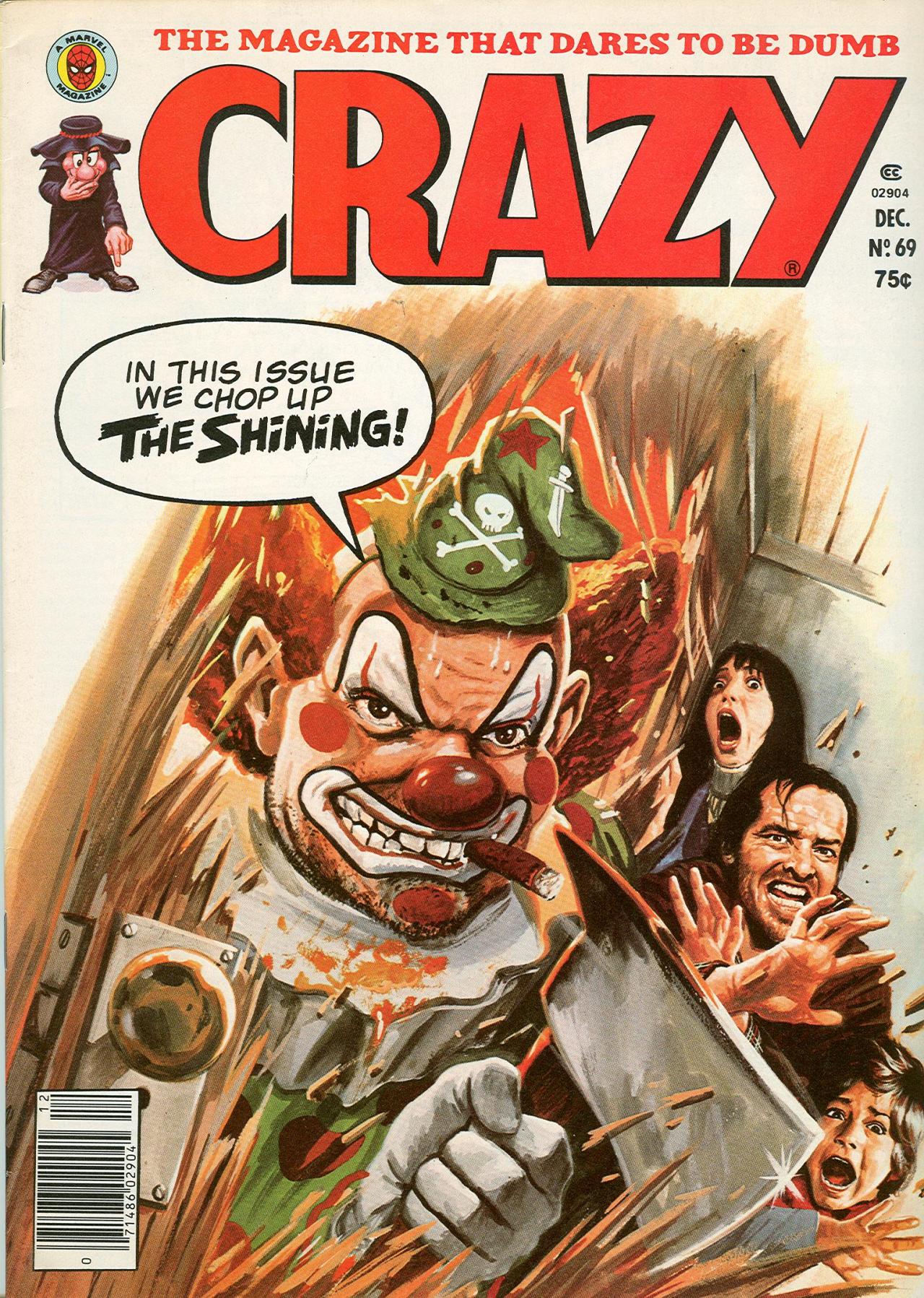
The fine folks over at The Overlook Hotel website have scanned and made available this 1980 comic parody of The Shining, which ran in MAD Magazine's ugly, red-headed, Peeping Tom kleptomaniac neighbor kid, CRAZY! In fact, it was that issue's cover feature, and you know what? It wasn't half bad!
Jeff Delgado's awesome illustrations are a deft blend of realism with stylized cartoons. The results are a distinctive style, which he employed to create a series of pieces based on The Shining. Check them out at the link above, and find out more on the artist’s DeviantArt and Facebook.
Animation scholar Tom Klein has done yeoman's work putting together this magnificent article for Cartoon Research discussing the potential influence that Kubrick's early love of hyper-violent cartoons may have played on his future film-making aesthetic. Entitled "Stanley Kubrick and Violent Cartoons: 1956", it begins:
In 1956, America was smitten with the good intentions of Alberta Siegel and suddenly cartoons were under scrutiny. For her Stanford doctoral work in psychology, she had arranged for twelve preschool children to watch the Comicolor cartoon The Little Red Hen (1934) and another twelve to watch what is described as “a Woody Woodpecker cartoon.” Afterward she observed the kids at play. You guessed it, she perceived the Little Red Hen group to be engaged in gentle play and the Woodpecker group was more likely to hit each other and break toys.
Meanwhile, in that same year, Stanley Kubrick directed his first succesful feature film, titled The Killing no less. It might seem insane to think that there are any cinematic links between these events, but as Kubrick’s career progresses the argument could be made that he had obviously watched some Woody Woodpecker. Not just any cartoons, but specifically the brutal ones directed by Shamus Culhane.
Klein goes on to dig up some potentially new information about the semi-infamous incident where Stanley's little sister, Barbara, became so incensed over his repeated playing of a Prokofiev record on the family hi-fi that she ripped the record off the turntable and smashed it (in some versions of the story, over his head). Klein points out some intriguing intersections between Culhane and Kubrick's oeuvre, including the fact that both directors were deeply influenced by Podovkin and Eisenstein's theories. He also states that "although they were 20 years apart in age, the zeitgeist of the 1940s proved to be a formative period for both of them, and in this decade they steeped themselves in classic literature, avant-garde cinema, and modern art."
One of the more fascinating aspects of Klein's essay is the part where he breaks down specific areas where Kubrick may have been influenced by Culhane, particularly in the case of A Clockwork Orange. Klein lists, then explains, numerous potential connections between Clockwork and Culhane's cartoons. He writes:
The scene that many consider to be the single most depraved in A Clockwork Orange is the home invasion. Preying on the kindness of strangers, the Droogs brutalize a middle-age couple while Alex sings and dances “Singin’ in the Rain.” This flips the smiling cheer of the American Musical on its head and leaves audiences gasping in horror to see Alex savagely beating a man during the improvised performance. Of course, Woody had performed his on-screen brutality almost thirty years earlier, but as directed by Culhane the sequence stays just on this side of comedy. Without any provocation, he repeatedly swings his weapon but the man keeps dodging and then Woody allows his victim to escape the barbershop. Kubrick took the same notion to a very dark place and, in doing so, his film endures as one of the most provocative polemics on a modern society diseased with narcissism and casual violence.
Whether or not there was any kind of direct influence involved, Klein's observation nevertheless rings very true, and is definitely one worth making. In fact, the entire essay is pretty much must-read material for any fan of Kubrick, classic cartoons, and cinema in general. It might also give you a newfound respect for the work of the Walter Lantz Studio's long neglected animators, who are due for a renaissance now that Disney, Warner Bros, and the Fleischer Studio cartoons have finally received the mainstream acclaim and renown they so clearly merit.
I'll leave you with the cartoon that Klein sees as being somewhat parallel to Clockwork: "The Barber of Seville". Enjoy!