
Showing posts with label short films. Show all posts
Showing posts with label short films. Show all posts
Friday, June 21, 2019

Monday, November 14, 2016
KUBRICK NEWS IN BRIEF ~ NOV 15, 2016
Can a one minute video montage provide sufficient evidence to convince you that Steven Spielberg was purposefully copying Stanley Kubrick's style when he devised the visual style palette for the misunderstood and underappreciated A.I.? The self-declared film geeks at Slash Film, AV Club and Nerdist seem to differ on the subject, though they all saw fit to feature Candice Drouet's video n their sites (just as I am doing now). As for myself, I figure if there's ever a time when it's okay to swipe a few Kubrick motifs, it's when you're finishing one of the man's long-gestating passion projects.
***
In this hilarious mini-memoir for the Financial Review, legendary spy novelist John Le Carre regales readers with an abbreviated version of his myriad Hollywood adventures, including a number of run-ins with this blog's raison d'etre. Here is one particularly amusing interaction...My first intimation of Stanley Kubrick's interest in adapting my novel A Perfect Spy for the big screen came when he called me up, wanting to know why I had turned down his offer for the movie rights. I had turned down Stanley Kubrick? I was amazed and horrified. We knew each other, for Heaven's sake! Not well, but enough.
Why hadn't he called me to tell me he was interested? And most extraordinary of all: what did my film agent think he was up to, not telling me he had an offer from Kubrick, then signing up the book with BBC television? Stanley, I said, I'm going to check this out at once and I'm going to get right back to you. D'you happen to know when you made this offer? As soon as I'd read the book, of course, David: why would I hang around?
My agent was as mystified as I was. There'd only been one film offer for A Perfect Spy apart from the BBC; but it was so trifling he hadn't thought to bother me with it. A Dr Feldman, I think his name was, of Geneva wished to acquire an option on the movie rights to my novel as a teaching tool for a course on book-into-film. It was a competition thing. The student who came up with the best screenplay would have the pleasure of seeing a minute or two of his work realized on the big screen. For the two-year option on the movie rights of A Perfect Spy, Dr Feldman and his colleagues were prepared to offer a five-thousand-dollar honorarium.
I was on the brink of calling Kubrick to assure him that his own offer had never reached me, but something held me back, so I called instead a big wheel in the studio Kubrick sometimes worked with: my friend John Calley. Calley gave a happy chuckle. Well, that sure as hell sounds like our Stanley all right. Always afraid his name is going to bump up the asking price.I have to say, if that story didn't put a smile on your face, then you probably aren't much of a Kubrick fan!
***

Did you folks know that, according to Jerry Lewis, he was the first person to offer up the now common witticism about it being impossible to polish a turd? That's according to Slate's history of the idiom, which includes Lewis' account, in which our man Stanley plays an important supporting role:
I was in my cutting room around 1 in the morning, and [Kubrick] strolls in smoking a cigarette and says, “Can I watch?” I said: “Yeah, you can watch. You wanna see a Jew go down? Stand there.” That was the night I coined the expression, “You cannot polish a turd.” And then Kubrick looked at me and said, “You can if you freeze it.”
Whether this actually happened or not, it certainly has the ring of truth!
***
Check out this article from the Los Angeles Times digital archives, dated April 17, 1959. It is described thusly:
Even before its release, the 1960 film epic “Spartacus” was dogged by rumors of tension on the set, with star-producer Kirk Douglas butting heads with MGM, and a young Stanley Kubrick replacing director Anthony Mann after a week of shooting. On April 17, 1959, the Los Angeles Times’ Phillip K. Scheuer reported after a visit to the set that the “only fighting goes on before cameras,” and that Kubrick is “reasonably in control of a situation still potentially explosive.”
Much more at the link.
Golly gee! Does this new commercial for Xiaomi's Mi Mix "edgeless" smartphone seem kind of familiar to you? I mean, give it a look, and maybe you can tell me!
Mmm... nope. I'm just not getting it, myself. Thank GOD there's the good people at Mashable, who appear to be willing to explain it all to my dumb, befuddled cracker mind. Thanks, guys!
***
When Hip Hop impressario Jay Z needed to pimp out the new West Hollywood digs for his Three Six Zero management company, he chose Optimist Design for the job. And when Optimist Design's chief architect Tino Schaedler needed a jolt of design inspiration, he turned to Stanley Kubrick. As partially explained in this Wallpaper.com article:The brief seemed simple enough: a space that balanced sophistication with star appeal, the latter particularly important given that Three Six Zero represents some of America’s biggest music, film, television and literary celebrities. Think Calvin Harris, Travis Scott, Brett Easton Ellis, Deadmau5 and Frank Ocean. ‘My background is in film,’ Schaedler says, referencing his stage design and production work at the Grammys for Daft Punk, Kanye West and Pharrell Williams, as well as set design on Burton’s Charlie and the Chocolate Factory and the Harry Potter films. ‘So I have always thought of space as a sequential experience. It’s important for us to consider how the space unfolds as you walk through it. On this project, Stanley Kubrick and his use of one-point perspective for the strong visual and emotional impact in The Shining and 2001: A Space Odyssey was an inspiration.’
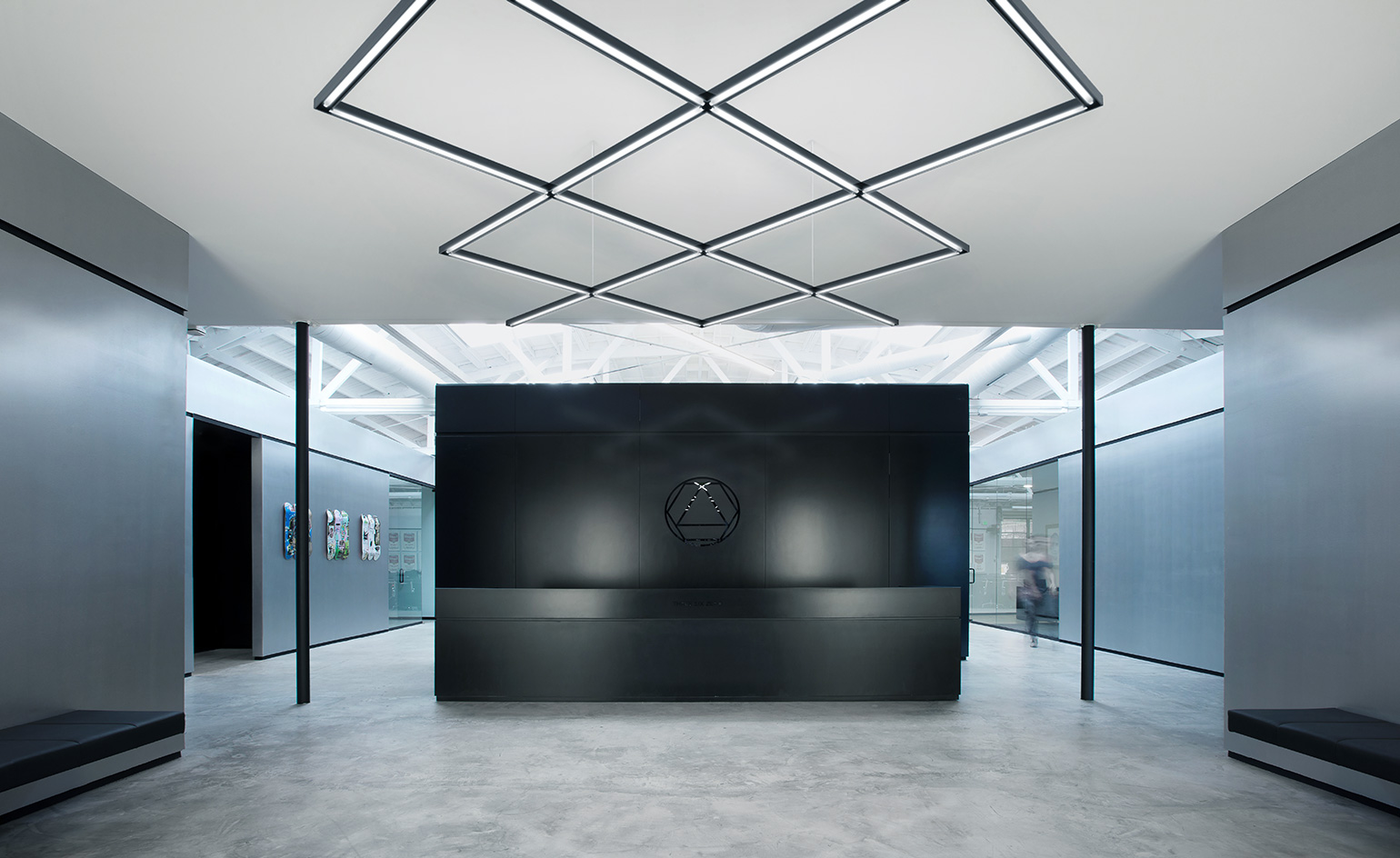
The Kubrickian influence is distinctive, particularly in the way the individual rooms and spaces, each designed almost like a set piece, have a symmetry and spatial depth. The conceit is a dramatic one and the tone is set the moment you step into the lobby – an austere volume lined on each side with a floating leather-clad bench, and dominated by a solid monolith of a reception desk with a black satin finish. Overhead hangs a flat chandelier in the form of a diamond-shaped trellis, a motif repeated in the open-plan office space and in the artists’ lounge.
I know it's probably Jay Z's intention to keep those Illuminati suspicions burning for as long as humanly possible, and building himself his very own James Bond villain lair is probably a great way to maintain that narrative. Mazel-Tov!
***
And speaking of the Illuminati, here's Vulture's rundown of the 70 Greatest Conspiracy Theories in Pop Culture History! From "Paul is dead!" to "Stevie Wonder isn't blind!" with a lot of Illuminati in between. This is no mere bullshit "listicle", friends... author Adam K. Raymond didn't just churn out this project like some desperate SEO-blinded blog-hack might, looking to pay for next month's ration of Soylent while expending the least possible effort and giving the least possible fucks. This is some substantial reading material. Unfortunately, if you're not big into the parapolitical side of the entertainment industry, you've got to wade through an awful lot of dubious claims about even more dubious "talents" before reaching the bit about how - you guessed it - Stanley Kubrick secretly shot the moon landing, and confessed to doing so "in code" in his film version of the Stephen King novel The Shining. Here is that section in its entirety.Stanley Kubrick directed the moon landing for NASA.
To believe this is true one must first believe a much larger conspiracy theory: That the moon landing was faked. Let’s take that at face value for a moment and dive into a sub-conspiracy that suggests Kubrick was hired to direct the footage used to trick the world into believing a man walked on the moon. Theorists say 2001: A Space Odyssey provided a model for NASA, which is why Kubrick was brought in by the space agency.
But it’s another movie that makes the strongest case for this whole story being true. The Shining is rife with clues that Kubrick did indeed direct the moon landings, according to theory’s chief proponent, Jay Weidner. He says Jack Torrance represented Kubrick himself. His deal with the manager of the Overlook Hotel, which represented America (red, white, and blue; built on an Indian burial ground), references Kubrick’s own deal with the U.S. government to help fake the moon landing. The snowstorm that traps the Torrance family in the Overlook is the Cold War, and the bears throughout the hotel symbols of Russia.
The scene that this theory relies on most heavily is the one that sees Danny Torrance rise from the hotel carpet, which looks like a NASA launchpad, wearing an Apollo 11 sweater. He approaches a room, No. 237, that represents the moon. We know this because the moon is 237,000 miles from the earth, theorists say (it’s actually 238,000 miles away, on average). Kubrick went out of his way to make this reference by changing the room number from 217, its number in Stephen King’s novel. Another noteworthy change is making the daughters of the hotel’s previous caretaker twins. It was only one child in the book, changed in the film to represent Gemini, the NASA mission that preceded Apollo.
This theory was given new life in late 2015 when a video surfaced with what was claimed to be footage of Kubrick admitting his role in the faked moon landings. The video was fake.The rest of this article contains plenty more entertaining idiocy of this nature, and even a couple that managed to give me a bit of a chill down the old spine. Your mileage may vary, but I still recommend giving it at least a quick look-over. Enjoy!
***
Golly gee! Does this new commercial for Xiaomi's Mi Mix "edgeless" smartphone seem kind of familiar to you? I mean, give it a look, and maybe you can tell me!
Mmm... nope. I'm just not getting it, myself. Thank GOD there's the good people at Mashable, who appear to be willing to explain it all to my dumb, befuddled cracker mind. Thanks, guys!
Subscribe to:
Posts (Atom)