Tuesday, May 31, 2016

KUBRICK IN THE NEWS


There has been a flurry of reports either about or referencing Stanley Kubrick and/or his films in recent weeks. Among them are included:

***

Not-so-hot on the heels of the dubious but intriguing "experimental artistic installation" The Shining Backwards and Forwards comes Jason Shulman's series Photographs of Film, in which, WiReD declares: "the narrative fades away" and the movie "is, instead, one scratchy, hazy frame." The results for the single frame version of 2001: A Space Odyssey are described thusly: "It's mostly black and gray, but you can make out the three screens of the council room, the tiled floor of the Louis XVI bedroom, and HAL 9000’s camera eye, glowing like an ember." See it above, and go to Shulman's page to ogle all the other frames, including The Shining's. My personal favorite is Voyage de la Lune, which takes on the aspect of an H.R. Giger hellscape.

***

VICE.com was one of the many media to run a story about Emilio D'Alessandro's 30 year career as Stanley Kubrick's trusted driver, assistant, and family friend. At one point in, VICE points out that
D'Alessandro worked with Kubrick from then until the director's death in 1999, serving as his personal driver, on-set assistant, and lifelong right-hand man on films from A Clockwork Orange to Eyes Wide Shut. Gradually, their relationship shifted from the merely professional to the personal. "I would always call him Mr. Kubrick," D'Alessandro recalls, "and one day he said, 'Emilio, pack that in, and just call me Stanley.'
Endearing as that story is, even better is the photo that accompanies the article, which is definitely one for the Kubrick-o-phile's archives. We've been seeing a lot of Kubrick and Emilio stories in the news lately - including this Movie Pilot article about how Emilio tried to convince Stanley not to hire Jack Nicholson for The Shining - because Emilio's book, Stanley Kubrick and Me: Thirty Years at His Side, has been translated into English and is currently on sale. BUY IT NOW! And use this link so I get a coupe sheckles in my begin' cup.


And then, of course, there's this Guardian article covering Kubrick's long-serving personal assistant Emilio's revelation that in 1999, while wrapping up Eyes Wide Shut, Kubrick was beginning to plan work on not one but two films: a World War II film about the bloody Axis/Allied conflict in Monte Cassino, and a kids-friendly version of the oft-filmed classic, Pinocchio. And no, Emilio is adamant that this would have been a separate project from A.I., which has frequently been described as having much in common with that classic tale.

***
Over at STV.tv, an autistic gentleman by the name of Mark McDonald watches The Shining for the first time in his life as part of that website's Classic Film Club, where "each week we invite a famous face to watch a classic film they have never seen and tell us if it lived up to the hype or left them throwing their popcorn away in disgust." Click through to read Mark's post-viewing interview/review. You won't be disappointed.
***

Another Kubrick story to generate lots of column inches recently, like this story at The Hollywood Reporter, was the revelation that "True Detective Emmy winner" Cary Fukunaga "is in talks to direct" an HBO miniseries based on Kubrick's unfinished Napoleon project. The miniseries, "based on Stanley Kubrick's research for a film dubbed his 'greatest never-made film' — a planned story on French Emperor Napoleon Bonaparte's 19th century struggle to bring Europe under his total control."

***

And, finally for today, here's a review of the dark period comedy Moonwalkers, in which the Stanley Kubrick plays a role not unlike that played by Jesus Christ in those mid-century sword-and-sandal epics like Ben-Hur and The Robe, and which begins:
When I read the premise of this film, I expected a light-hearted conspiracy romp around swinging 60s London. What I did not expect was an exploitation schlock-fest of drugs, tits, and exploding heads. I’m not saying this is a bad thing necessarily, I’m just saying that maybe the press release could do with a tweak.

GREAT QUOTE ABOUT KUBRICK

Hidden away in the comments section of a Guardian article about Emilio D’Alessandro's recent revelation about how Kubrick "was planning his first children’s film and his first second world war movie shortly before his death in 1999" is a comment so perfect that I just had to share it here with all my fellow Kubrick fanatics, so that it is preserved somewhere in perpetuity, or at least for as long as this blog shall last. So thanks, Guardian reader Toner4Ever (you with your Captain Picard profile pic), for sharing your insight with us all:

"Kubrick wasn't a director who was a genius, he was a genius who happened to be a director."

THE SHINING AND THE UNCANNY (GREAT SHORT VIDEO)


From the video's description on Youtube: "In this video essay we'll be looking at how Stanley Kubrick using Sigmund Freud's theory of the uncanny to great effect in his 1980 film, The Shining, based on the novel by Stephen King."

KUBRICK AND SOUND DESIGN

NoFilmSchool.com has published a couple of short, interesting articles that should be of interest to all Kubrick fans. The first one covers How Kubrick Built Atmosphere with Diegetic Sound, proclaiming our Stanley as having provided us with "one of the finest examples of diegetic sound that we have to date". It continues:
With so many other revolutionary filmmaking techniques in his repertoire, it's not often we find ourselves focused on Stanley Kubrick's audio strategies. His favoritism of diegetic over non-diegetic sounds, however, was essential in building the atmosphere for nearly every one of his films. Candice Drouet's 1.000.000 Frames series chronicles just that:


The article continues after the above video, going on to describe what diegetic sound is, exactly (it isn't that difficult a concept to grasp), and pulls out a few more examples of what they proclaim to be some of Kubrick's best work using the technique.

***

The second NoFilmSchool.com article asks What is Contrapuntal Music, and How did Kubrick and Tarantino Use it in Their Most Famous Scenes? It goes into great detail in an effort to describe what is, in essence, simply the use of music that not only doesn't tell the viewer how to feel, but is actually expressive of the opposite emotion that the onscreen events would likely inspire. Think Kubrick's use of "We'll Meet Again" at the end of Strangelove, when the fact of the matter is that (SPOILER) with every human being on the face of the Earth killed by the Soviet Doomsday retaliation, we actually will NOT be meeting again, ever.

Tuesday, April 26, 2016

TRAPPED BY KUBRICK'S FRAME


I lost count of the number of times I've seen The Shining a long time ago, and yet I still occasionally find myself discovering new things and/or encountering new insights about it. One case in point is from this Pink Smoke article about Rodney Ascher's Room 237, which contains the following paragraph:
I should also mention that the reason I asked Adam to join Marcus and myself for this panel is that, other than knowing he's a huge Shining and Kubrick fan, he once proposed the most compelling insight I've ever heard about the movie: the fact that none of the characters exit the frame under their own power until the very end, when Wendy and Danny escape in the Snow Cat. The characters are trapped, not just geographically in the snowbound hotel, but inside Kubrick's unrelenting lens. I've never sat and paid attention to the film closely enough to see how consistently Adam's theory sticks, but every time I happen to catch part of the film on TV it seems close enough, and makes for a much more palpable origin for the film's inescapable tension that undoubtedly compelled the Room 237 talking heads to over-analyze it in the first place.
Now, I also have yet to personally verify this theory, but I can't think of any exceptions off the top of my head, and you can bet I'll have a note pad and pencil with me the next time I watch The Shining, which shouldn't be too long from now.

AN ELECTRICIAN REMEMBERS WORKING ON THE SHINING


Here's a great piece in The Guardian, penned by Bob Tanswell, who landed a gig as an electrician on the set of The Shining back in 1979. That's him up there, top left. Some of his recollections are pretty funny. Great trivia. Quick read.

JOE TURKEL ON HIS ROLE IN THE SHINING

Okay, so this is a weird one. Some feller by the name of Media Mike--whose first language obviously isn't English--got a chance to chat with actor Joe Turkel at one of those "meet a celebrity" autograph conventions. Turkel is most famous for playing Lloyd the bartender in The Shining and Eldon Tyrell in Bladerunner, but he also had roles in two earlier films by Kubrick: The Killing and Paths of Glory. In The Killing, Turkel was little more than a glorified extra, but in Paths of Glory, he played Private Arnaud, a philosophically inclined chatterbox who is one of three French soldiers chosen to be executed for cowardice after a failed attempt to overtake a position held by the Germans. In any case, regardless of the site's broken English, it's nice to know that Turkel is still alive and mentally sharp at 88.

BARRY LYNDON: KUBRICK'S OVERLOOKED MASTERPIECE


From the "Must See Films" series comes this wonderful 19-minute analysis of Kubrick's beautiful adaptation of Thackeray's picaresque novel The Luck of Barry Lyndon. Some people may think Kubrick made Barry Lyndon as some kind of personal consolation project after Napoleon fell through at MGM--I mean, why let all those years of research go to waste, right?--but simply watching the film is enough to dispel that ridiculous notion.

AESOP ROCK REMAKES THE SHINING


I suppose I would be remiss if I didn't bring you hip hop artist Aesop Rock's 48-minute remake of The Shining, all done in miniature, to accompany the release of his latest album, The Impossible Kid. This IndieWire article has all the particulars

Wednesday, April 20, 2016

AWESOME NEW CLOCKWORK ORANGE POSTER

UPDATE!!!

Seeing as the image link below is broken, and seeing as the people who were selling it as both a print and a t-shirt no longer have it up for sale at their site, and seeing as I can't even find a link anywhere online for it, I'm going to go ahead and assume that Warner Bros sent them a cease and desist, and they complied, post-haste. I'm going to leave this broken link up here as a kind of tribute to the fragile impermanence of digital culture. If I ever find out what went down, I'll obviously be filling you guys in. - Yer Old Pal Jerky


The only change I would have made is to have the nipples bleeding milk instead of blood. Otherwise, this is gorgeous. You can purchase this beautiful piece of art (and a variant) at Cult Classic Prints.

Tuesday, April 19, 2016

KUBRICK ESTATE NAME-CHECKED IN PANAMA PAPERS DOCS-DUMP


This Newsweek report on Stanley Kubrick's estate's offshore financial holdings (in this case, via the British Virgin Islands) set up by Panama-based law firm Mossack Fonseca, as recently revealed by Münich-based newspaper Süddeutsche Zeitung, has some interesting information, and a whole lot of factual errors. 

Take this single paragraph:
The reason Kubrick took such pains to keep the house in his family is not hard to fathom: He chose to be buried on the grounds of Childwickbury Manor, under his favorite tree. One of his two daughters with Christiane, Anya, who died later in 2009, is also buried on the 1,100-acre estate. Christiane now lives at the manor with her other daughter by Kubrick, Vivian, and a third daughter she’d had prior to their marriage, Katharina, as well as her grandchildren. After shooting scenes there for the end of Kubrick’s 1980 film The Shining, which featured some of the grounds, Jack Nicholson once observed that Childwickbury Manor was, more or less, a family compound, and that Kubrick was “very much a family man.”

Let's play a game, shall we? Can YOU list all the errors contained in the above paragraph? Submit your answers in the comments section below!

Meanwhile, perhaps the most important non-erroneous factoids to take away from this article include a) the fact that tax avoidance does not always mean tax evasion, b) that Kubrick, his companies and his estates paid out large sums of taxes to both American and UK authorities over the years, and c) that our man Stanley isn't accused of doing anything illegal. And even if he were... that still wouldn't alter the fact that his movies are genius.

Now start picking apart that paragraph!

Monday, April 18, 2016

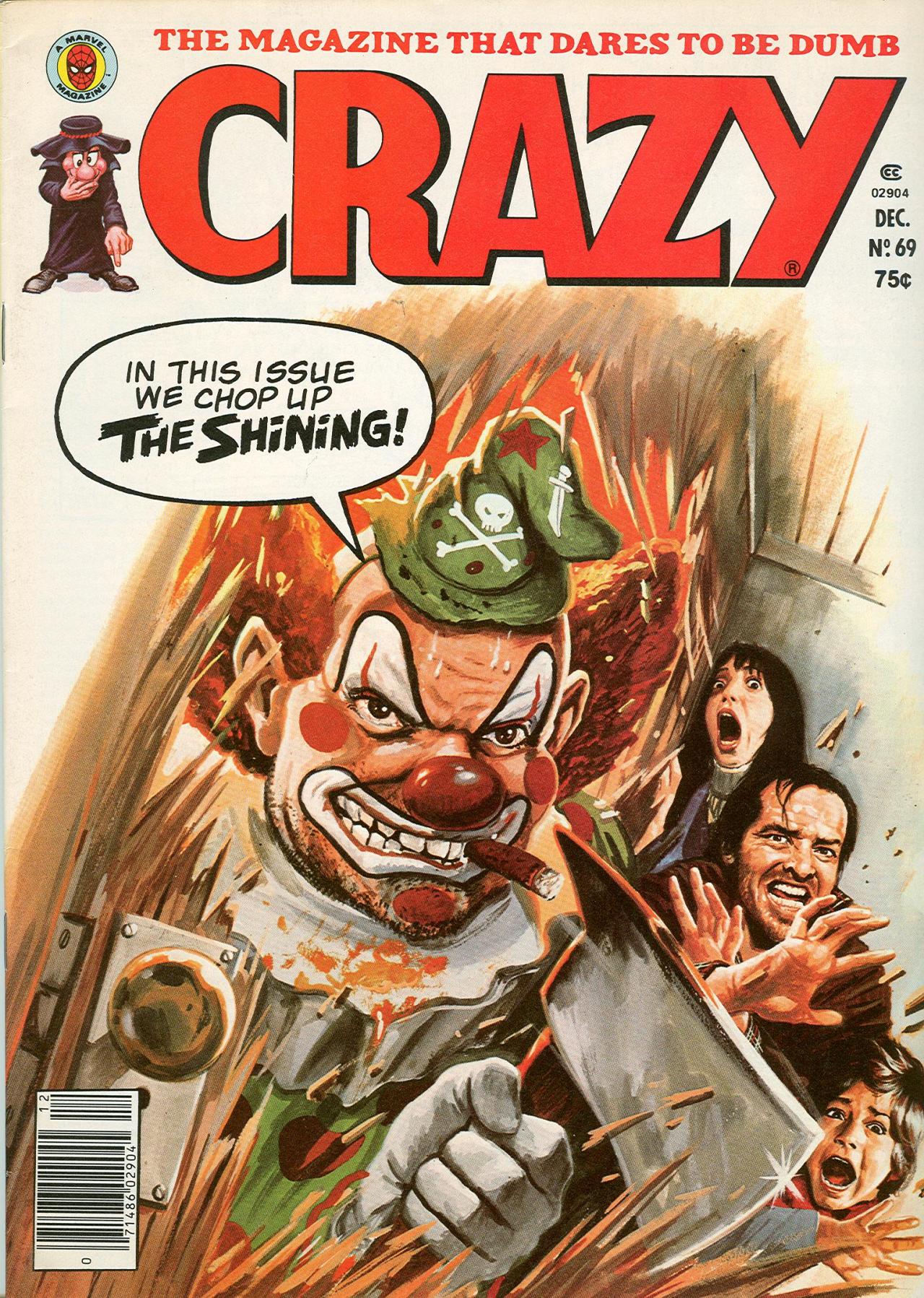
CRAZY MAGAZINE'S COMIC PARODY OF THE SHINING (1980)


The fine folks over at The Overlook Hotel website have scanned and made available this 1980 comic parody of The Shining, which ran in MAD Magazine's ugly, red-headed, Peeping Tom kleptomaniac neighbor kid, CRAZY! In fact, it was that issue's cover feature, and you know what? It wasn't half bad!

Friday, April 15, 2016

JEFF DELGADO'S AMAZING "THE SHINING" ILLUSTRATIONS


Jeff Delgado's awesome illustrations are a deft blend of realism with stylized cartoons. The results are a distinctive style, which he employed to create a series of pieces based on The Shining. Check them out at the link above, and find out more on the artist’s DeviantArt and Facebook.

Wednesday, March 30, 2016

HOW A COMPUTER LEARNED TO KILL, BY ALAN KELLEY

Reader Alan Kelley has put together a handsome video featuring a very well reasoned argument about how we may all have missed some important clues regarding both the potential reasons why, and the potential ways in which, HAL so suddenly turns into a homicidal maniac in 2001: A Space Odyssey.  He generously sent it to me to share with you all, and you may either watch it here, or on Youtube (for more viewing options). Just a word of warning: there are two minutes of clips before Alan begins making his argument, and his voice-over is mixed kind of low, but it's still very much worth our time.


Monday, March 28, 2016

8 INCREDIBLE THINGS YOU (PROBABLY) DIDN'T KNOW ABOUT THE SHINING


At this point, you've got to work really hard to dig up something new to me regarding the films of Stanley Kubrick... especially when it comes to The Shining. And yet somehow, this MoviePilot article by Manny Serano manages to do so, more than once. 

Yes, some of the points raised here are familiar, such as the pretty obvious mirror motif that Kubrick uses to powerful effect throughout the film. Some are also specious, as in the elaborate theories woven from the infinitely flimsy fabric of minor discrepancies in set continuity (although from the image below, there's no denying Kubrick was incredibly attentive to "the little things"). But there's more than enough fresh information here to make wading through the shallow, lazy bits worthwhile. 


A particularly entertaining example is the list of things that Kubrick "flipped" from King's novel for his adaptation of it, which itself is just a severely foreshortened version of the huge list of "flips" found at this link. 

Another great bit concerns the notorious "All work and no play make Jack a dull boy" scene. By now, most of us are familiar with the story. Instead of using simple computer code, or even a photocopier, to lighten the load, Kubrick had some poor schmuck type out dozens of pages covered with that single sentence, over and over again; a task which must have seemed like the dictionary definition of monotony. But no matter how crazy you think this anecdote is, it's actually five time crazier, because rather than just have the phrase translated into subtitles for the international market, like 99.999% of filmmakers would have done, Kubrick made the typist repeat his Herculean feat in French, German, Italian and Spanish!

On a personal level, Serano's elaboration on how Kubrick directed his actors actually cleared up a few things for me, added to my critical lexicon, and opened up potentially exciting new avenues of inquiry.  For instance, both here and at my sister-site, Useless Eater Blog, I'll definitely be looking into how "Semantic Satiation" and "Dichotic Verbal Transformation" might figure into various esoteric art and acting techniques. 

Beyond the novelty of a few fresh observations, Serano's piece has many other attributes that make it worthy of your time. It's well researched, richly illustrated, packed full of videos and external links that are both entertaining and informative, and it's presented in an easily digestible format. That makes it great for sharing with any friends or acquaintances who may first be coming across Kubrick's films and are interested to find out more. 

Bottom line: This is the best general interest Kubrick article that I've come across in months, and that's saying something!