
This is the second in a series of meditations on Kubrick's earliest works, and the way image and moments from those works echo through his entire career. Click here for the first installment. - MT
Stanley Kubrick's second film was 1951's Flying Padre, a documentary short subject about Father Fred Stadtmueller, a Catholic priest from New Mexico who uses a Piper Cub airplane - the "Spirit of St. Joseph" - to reach all the various far-flung ranches and settlements that fall within the vast territory covered by his parish.
With a skimpy runtime of just over 8 minutes, Flying Padre is a rather slight contribution to Kubrick's oeuvre, and in many ways can be seen as a bit of a step backwards from the promising premiere that he'd made with Day of the Fight. Indeed, the only reason Kubrick made Flying Padre was because RKO-Pathé - who had admired and purchased Day of the Fight - paid him $1,500 up front to do so... with the understanding that all expenses, including travel, film and equipment rental, would be covered by that meagre fee. The legendary "Kubrick thrift" held him in good stead, as he managed to break even!
Let's take a moment to watch Flying Padre together, shall we?
Considering the massive constrictions Kubrick had placed on him, both budgetary and otherwise, it's kind of amazing that he managed to pack so much information and story into such a tight little documentary package. Also, for all its flaws - the lame attempt at injecting an element of suspense with the "sick baby" bit at the end, for instance - one still can't help but spot images and moments that would continue to echo through Kubrick's oeuvre as his budgets, ambition and pretensions would skyrocket beyond anything his cinematic peers would even dare to dream of. And this, beyond the mere use of a narrator, which was a hallmark of Kubrick's early style. In fact, I found more to remind me of future Kubrick films in Flying Padre than I did in Day of the Fight!


Pretty cool, no? And I love how Kubrick captured Father Stadtmueller looking back over his shoulder in this shot, as occurs a number of times with a variety of characters in Dr. Strangelove or How I Learned to Stop Worrying and Love the Bomb. Of course, the Leper Colony had a few more controls and dials...


Kubrick's love of aerial shots can be seen in Strangelove, of course, as well as in 2001, during the "Stargate" sequence, and of course, during the opening shots of The Shining.


This one's a bit of a long shot, but there's something about the priest leading the funeral party in Flying Padre that reminded me of the priest leading the funeral party in Barry Lyndon.


Another long shot, but I think there's something a little bit "Eyes Wide Shut" about the Church ceremony we're shown.


A bit less of a stretch is how much Father Stadtmueller resembles the Clockwork Orange padre in certain moments.


Here's one that didn't remind me of any future Kubrick framings, but I did think it might be sort of a sly little anti-clerical subliminal cue planted by Kubrick in his otherwise laudatory little spit-shine of a documentary. I mean, it's a priest, visually trapped in a theological or moral "cage", just like his canaries are trapped in a real-life one! And - unlike his canaries, which he breeds for profit - the priest can't even pro-create!

Although Father Stadtmueller is, without a doubt, nowhere near as threatening a personage as Timothy Carey from The Killing, nevertheless, I couldn't help but be reminded of him when I saw this shot.


Heck, there's even something to remind me of Full Metal Jacket in this movie!


And finally, I apologize for the morbidity of this last selection, but when I first saw the awkward stance that the mother took while comforting her "sick" baby, I couldn't help but think of this similarly staged scene from Eyes Wide Shut.


Okay! So with all of the above speculation out of the way, let's bid a fond adieu to a priest who seems like he was probably a pretty swell guy back in the day. So long, Father Stadtmuller! Until next time, when we tackle The Seafarers!

Considering the massive constrictions Kubrick had placed on him, both budgetary and otherwise, it's kind of amazing that he managed to pack so much information and story into such a tight little documentary package. Also, for all its flaws - the lame attempt at injecting an element of suspense with the "sick baby" bit at the end, for instance - one still can't help but spot images and moments that would continue to echo through Kubrick's oeuvre as his budgets, ambition and pretensions would skyrocket beyond anything his cinematic peers would even dare to dream of. And this, beyond the mere use of a narrator, which was a hallmark of Kubrick's early style. In fact, I found more to remind me of future Kubrick films in Flying Padre than I did in Day of the Fight!
Here are a few of the more defensible cases in point...
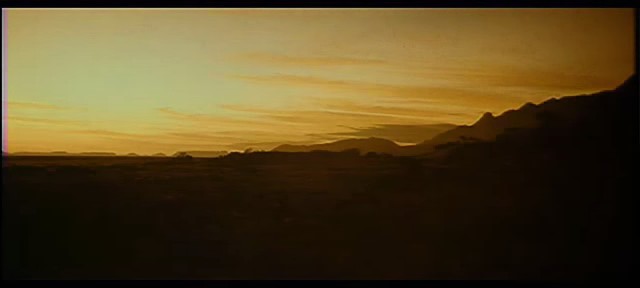
For instance, when I first saw the post-title shots - slow panning shots of the dry, arid wastes of the American Southwest - I couldn't help but be reminded of the opening shots of 2001: A Space Odyssey, which were pretty darn similar.

Pretty cool, no? And I love how Kubrick captured Father Stadtmueller looking back over his shoulder in this shot, as occurs a number of times with a variety of characters in Dr. Strangelove or How I Learned to Stop Worrying and Love the Bomb. Of course, the Leper Colony had a few more controls and dials...
Kubrick's love of aerial shots can be seen in Strangelove, of course, as well as in 2001, during the "Stargate" sequence, and of course, during the opening shots of The Shining.


This one's a bit of a long shot, but there's something about the priest leading the funeral party in Flying Padre that reminded me of the priest leading the funeral party in Barry Lyndon.


Although Father Stadtmueller is, without a doubt, nowhere near as threatening a personage as Timothy Carey from The Killing, nevertheless, I couldn't help but be reminded of him when I saw this shot.

Heck, there's even something to remind me of Full Metal Jacket in this movie!
And finally, I apologize for the morbidity of this last selection, but when I first saw the awkward stance that the mother took while comforting her "sick" baby, I couldn't help but think of this similarly staged scene from Eyes Wide Shut.

Okay! So with all of the above speculation out of the way, let's bid a fond adieu to a priest who seems like he was probably a pretty swell guy back in the day. So long, Father Stadtmuller! Until next time, when we tackle The Seafarers!


